A branded power bank is one of the most genuinely useful gifts a company can hand out, which is exactly why it so often travels. Recipients throw it in a carry-on for a conference, a sales trip, or a holiday, and that is the moment airline battery rules come into play. Those rules tightened noticeably through 2025, and a gift that cannot clear security or that a flight attendant makes someone stow away is a poor advertisement. The good news is that the regulations are clear and that almost every promotional-sized power bank is well within them, provided you understand the one number that governs everything.
Watt-hours, not milliamp-hours, are what the rules measure
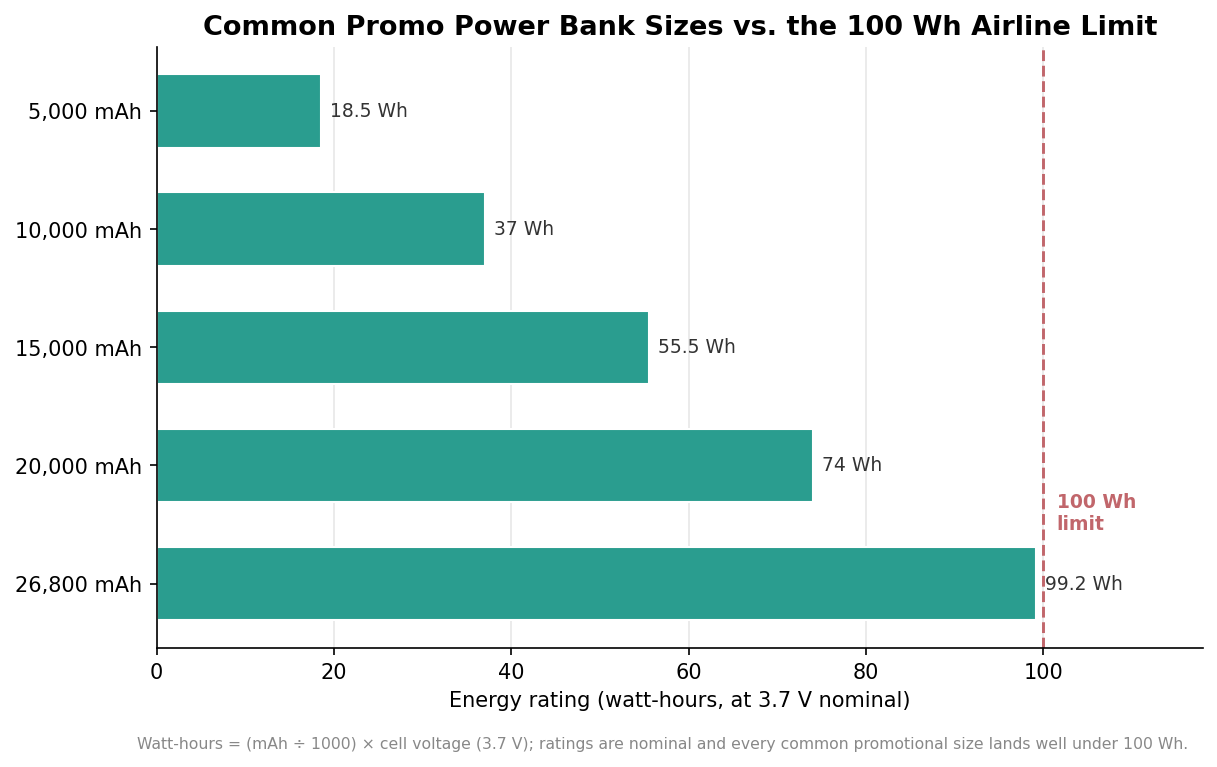
Airlines and aviation regulators do not limit power banks by the milliamp-hour figure printed on the front. They limit them by energy, measured in watt-hours, because watt-hours reflect how much energy could be released in a fault. The conversion is simple: take the capacity in milliamp-hours, divide by 1,000 to get amp-hours, and multiply by the cell voltage, which for the lithium cells inside almost every power bank is a nominal 3.7 volts. A 10,000 mAh bank is therefore about 37 watt-hours, and a 20,000 mAh bank about 74 watt-hours. The regulatory ceiling that matters most, 100 watt-hours, works out to roughly 27,000 mAh, which is larger than the vast majority of promotional units.
Every common promotional capacity from 5,000 to 20,000 mAh sits well under the 100 Wh carry-on limit.
The practical consequence is reassuring for anyone ordering swag. The popular gifting capacities, from a slim 5,000 mAh up to a substantial 20,000 mAh, all sit comfortably under the 100 watt-hour line, so they need no special permission and travel as ordinary carry-on items. It is only when a bank pushes toward 26,800 or 27,000 mAh that it approaches the threshold, and a few oversized units climb past it.
The three capacity zones
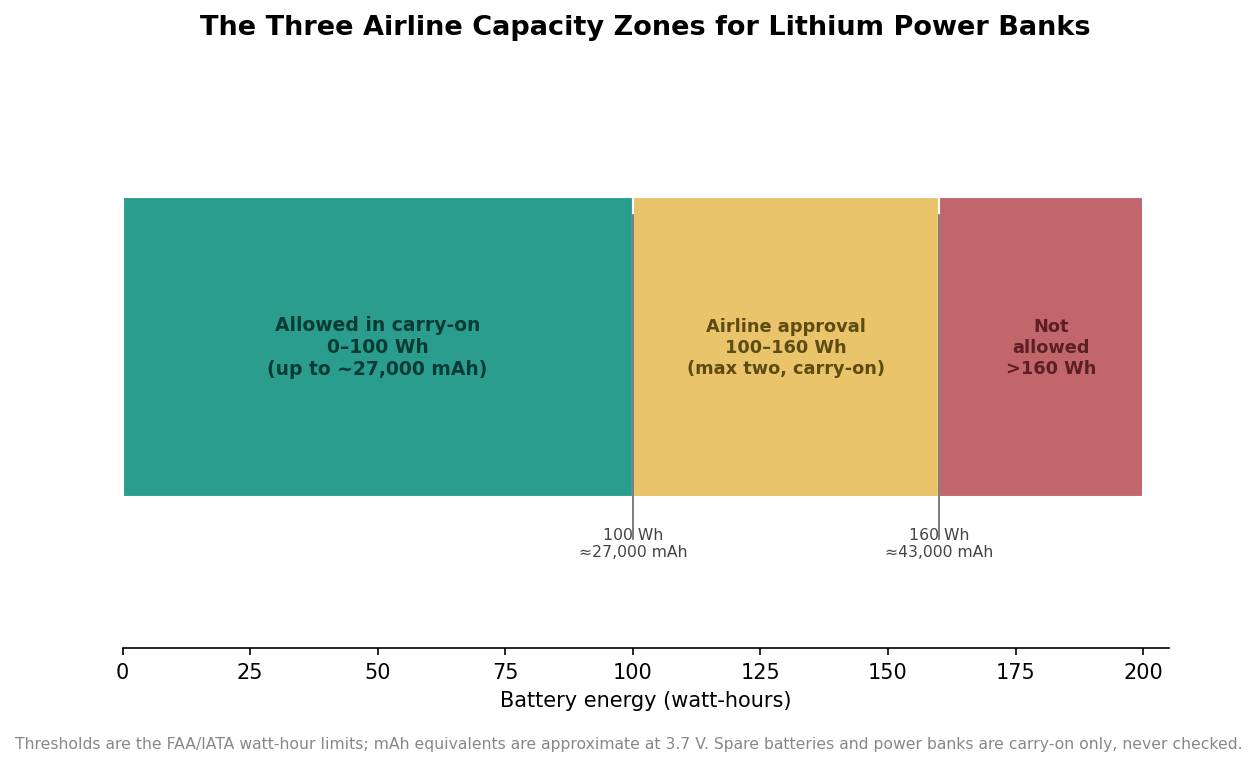
The rules sort lithium power banks into three bands. Anything up to 100 watt-hours is allowed without approval and is the zone every sensible promotional product should live in. From 100 to 160 watt-hours, a bank is permitted only with the airline’s advance approval, and passengers may carry a maximum of two such batteries. Above 160 watt-hours, which corresponds to roughly 43,000 mAh, spare batteries and power banks are simply prohibited from passenger aircraft. One rule spans all three bands and catches people out constantly: power banks and spare batteries must travel in carry-on baggage and are forbidden in checked luggage, because a fire in the hold is far harder to fight than one in the cabin.
The three regulatory bands by watt-hours, with approximate mAh equivalents at 3.7 volts.
Carry-on only, and the short-circuit rule
The carry-on requirement is worth restating because it is the rule travelers break most often by habit. A power bank tucked into a checked suitcase is not a minor infraction; spare lithium batteries and power banks are forbidden in the hold outright, because cabin crew can respond to a fire they can see and reach. Alongside that, regulators require spare batteries to be protected from damage and short circuit, which in practice means keeping a power bank away from keys, coins, and loose metal that could bridge its ports. For a promotional unit this is a small design point with real value: a recessed or capped USB port, a hard shell rather than a bare cell, and a housing that survives being knocked around a bag all make the gift both safer and more likely to keep working. It is a reminder that build quality and compliance are the same conversation, not two separate ones.
The 2025 change: keep it in reach and don’t charge it in flight
The newer wrinkle is not about capacity at all but about how a power bank is stored and used during the flight. After a series of in-cabin battery fires, including incidents on Air China and Air Busan flights and a run of lithium battery events across US aviation in 2025, a large group of carriers changed their in-flight rules. The Lufthansa group of airlines, along with Southwest, Qantas, Emirates, Singapore Airlines, Cathay Pacific, Korean Air, Thai Airways and others, now variously prohibit using or charging a power bank in flight and require that it be kept within reach, under the seat in front or in the seat pocket, rather than in an overhead bin where a fault could smolder unseen. The exact wording differs by airline and continues to evolve, so the honest guidance to pass along with a gift is to keep the power bank accessible, avoid charging from it during the flight where prohibited, and check the specific airline’s current policy before flying.
What to specify for a power bank that travels well
For a corporate gift, the design brief writes itself once the rules are clear. Choose a capacity in the everyday range, roughly 5,000 to 20,000 mAh, which keeps the unit far below the 100 watt-hour limit and out of the approval bracket entirely; a 10,000 mAh unit around 37 watt-hours is a common sweet spot that charges most phones once or twice while staying pocketable. Insist that the supplier’s cells carry the standard lithium transport testing, commonly referenced as UN38.3, and that the finished unit shows its watt-hour or capacity rating clearly on the housing, because a bank with no legible rating is the one most likely to be questioned at a checkpoint. Steer clear of very high-capacity 30,000 mAh-plus units for broad giveaways, since those are the ones that flirt with or cross the approval line.
None of this should discourage a power bank as a gift; it argues for choosing the right one. A well-specified unit in the common capacity range is not just compliant, it is the version people can actually use everywhere they go, which is the whole point of putting a logo on it. Match the capacity to the rules and the printing to the brand, and the gift keeps working long after the event, in exactly the airports and airline seats where a dead phone is most frustrating.
A custom power bank sounds like a single product category until you start getting quotes. One supplier will sell you 50 units in five business days; another wants a 1,000-piece minimum and twelve weeks. Both are technically selling a “custom power bank,” but they’re not selling the same thing, and the price gap between them can be 5x per unit. Before you send a purchase order, it helps to know which route you’re actually buying into.
This guide walks through what a custom power bank costs by battery capacity, what minimum order quantities and lead times look like at each tier, and the battery-shipping rules that quietly add weeks to a timeline if nobody flags them up front. The numbers below come from current supplier pricing pages and sourcing guides, cited inline.
Decorated MOQ
50-100 units
Full OEM MOQ
1,000-5,000 units
Decorated lead time
2-5 business days
Full OEM lead time
12-16 weeks
Source: Quality Logo Products, 4imprint.com, and esccharge.com “USA OEM & ODM Power Bank Services 2026” guide — checked August 2026
Decorated stock vs. full OEM: two different products called “custom”
Almost every custom power bank sold today falls into one of two production models, and they behave differently on price, MOQ, and turnaround.
Decorated stock power banks
These are pre-molded shells the supplier already keeps in stock or can build fast, decorated with your logo via screen print, laser engraving, or a light-up imprint. This is what most promotional products distributors sell: Quality Logo Products lists a 2,200 mAh Color Block Power Bank at a 50-unit minimum from $5.44 each, a 2,600 mAh metal power bank at a 50-unit minimum from $17.24 each, and a 4,000 mAh Slim Power Bank at a 50-unit minimum from $10.91 each. 4imprint’s decorated 10,000 mAh models (bamboo shell, wireless charging, solar) list separate one-time setup charges of $55-$60 per imprint color or location and ship in as little as 2-5 business days once art is approved. There’s no mold work here — you’re customizing an existing product, not designing a new one.
Full OEM and configurable OEM power banks
This route builds the power bank around your brand instead of printing on top of one. A “configurable OEM” order lets you pick a manufacturer’s validated internal platform and customize the shell color, logo placement, packaging, and basic firmware, typically at a 100-500 unit MOQ with an 8-12 week lead time. “Full OEM” goes further — a custom-designed shell, custom mold, and often custom firmware — which pushes MOQ to 1,000-5,000 units and lead time to 12-16 weeks because tooling, sampling, and compliance testing all have to happen before production runs.
What a custom power bank costs, capacity by capacity
Capacity is the biggest lever on price, but it isn’t the only one — metal housings, wireless charging coils, and ruggedized cases each add cost independent of battery size. Still, the pattern below holds across both decorated and OEM suppliers: price climbs steadily with mAh rating, then jumps again for ruggedized or high-output models built for outdoor or industrial branding.
If you’re quoting a run, use these as a sanity check against what a supplier sends back. A 10,000 mAh USB-C PD unit quoted well outside the $14.20-$19.80 range, for example, is worth a second look — either the supplier is padding margin or including a feature (wireless charging, fast-charge output, custom mold) the quote doesn’t spell out.
Per-unit price roughly triples from a basic 2,200 mAh decorated bank to a 20,000 mAh OEM ruggedized bank.Source: Quality Logo Products pricing pages (qualitylogoproducts.com) for 2,200-4,000 mAh decorated units; Alibaba Bulk Power Banks Sourcing Guide 2026 (electronics.alibaba.com) for 10,000-20,000 mAh OEM unit price ranges — checked August 2026
Minimum order quantities and lead times by route
MOQ and lead time move together, and they move against per-unit price: the routes with the lowest minimums ship fastest but cost more per piece at low volume, while OEM tooling only pays off once you’re ordering in the thousands. The table below lines up the three routes buyers actually encounter when they request quotes.
Notice that the biggest lead-time jump isn’t between decorated and configurable OEM — it’s between configurable OEM and full custom OEM, where a new mold and first-article compliance testing add roughly a month before regular production even starts.
MOQ and per-unit price both scale with how much of the product is actually custom-built versus decorated.
MOQ and per-unit price both scale with how much of the product is actually custom-built versus decorated.Source: Quality Logo Products and 4imprint.com pricing/production pages; esccharge.com “USA OEM & ODM Power Bank Services 2026” guide; Alibaba Bulk Power Banks Sourcing Guide 2026 (electronics.alibaba.com) — checked August 2026
Certification and battery shipping rules that affect your timeline
A power bank is a lithium battery with a shell around it, and that changes how it can legally travel — which matters if your “12-week lead time” quote assumes air freight and the factory later tells you it has to go by sea. UN 38.3 testing is mandatory for shipping lithium cells and batteries by air, sea, rail, or road, and it applies to power banks specifically under UN 3480 when they’re shipped separately from the device they charge. Every legitimate supplier should be able to produce a UN 38.3 test report on request; if they can’t, that’s a red flag, not a paperwork formality you can skip.
Capacity also gates how a power bank can fly: units up to 100 Wh are generally allowed on passenger aircraft without special approval, while 101-160 Wh units need airline approval before they’ll be accepted, and anything above that typically has to move by sea. As of 2026, batteries shipped by air also have to be charged to no more than 30% state of charge before they’re packed, unless the battery is already installed and running inside its end device. None of this blocks you from ordering a custom power bank — it just means you should ask your supplier which shipping mode your quote assumes, because a switch from air to sea can add three to five weeks that no one mentioned at the quoting stage.
Choosing the right route for your order
If you need a few hundred branded power banks for a conference, a client gift box, or a new-hire kit, the decorated route is almost always the right call — lower MOQ, faster turnaround, and the per-unit price difference doesn’t matter much at that volume. If you’re building a retail SKU or a recurring corporate order in the thousands, configurable or full OEM starts to make financial sense: the mold and tooling costs amortize across enough units that the lower per-piece price wins out, and you get a shell nobody else’s promo catalog has.
The middle tier — configurable OEM at 100-500 units — is worth asking about even if you assume you need full custom. It gets you a distinct-looking product (not a shell every competitor can also order) without the 1,000-unit minimum and four-month runway that full OEM demands. Many buyers default straight to “we need our own mold” when a configurable platform would have hit the brief at a third of the MOQ.
Frequently asked questions
What’s the minimum order for a custom power bank?
It depends on the route. Decorated stock power banks (your logo printed on an existing shell) typically start at 50-100 units. Configurable OEM orders, where you customize color, logo, and packaging on an existing platform, usually start at 100-500 units. Full custom OEM with your own mold generally requires 1,000-5,000 units.
How much does a custom power bank cost per unit?
Basic 2,200-4,000 mAh decorated units run roughly $4.94-$17.24 each depending on capacity and housing material. Larger 10,000 mAh OEM units run about $14.20-$19.80, and 20,000 mAh ruggedized OEM units run about $32.50-$41.00. Setup charges for imprinting (often $55-$60 per color/location) and any mold or tooling fees on OEM orders are billed separately from the per-unit price.
How long does it take to get a custom power bank order?
Decorated stock orders typically ship in 2-5 business days after artwork approval, not counting freight transit. Configurable OEM orders run 8-12 weeks. Full custom OEM orders with a new mold and design run 12-16 weeks, since tooling and compliance testing have to happen before mass production starts.
Do custom power banks need special certification to ship?
Yes. UN 38.3 testing is mandatory for lithium battery shipments by air, sea, rail, or road, and applies to power banks under UN 3480 when shipped separately from the device they charge. Ask your supplier for the UN 38.3 test report before approving a production run.
Can a custom power bank be shipped by air?
Usually, up to a point. Units up to 100 Wh generally fly without special approval; 101-160 Wh units need airline approval; larger units typically move by sea. As of 2026, air-shipped batteries also need to be charged to 30% state of charge or less unless already installed in the device, which is worth confirming with your supplier since it can affect packing and timeline.
What’s the difference between a decorated power bank and an OEM power bank?
A decorated power bank uses a supplier’s existing shell with your logo printed, engraved, or lit up on the surface — fast and low-minimum. An OEM power bank is built around your specifications, from a shared configurable platform (lower MOQ, faster) up to a fully custom mold and design (higher MOQ, longer lead time, higher tooling cost but lower per-unit price at volume).
The bottom line
The right way to shop for a custom power bank is to decide your volume first, then let that number pick the route. Under a few hundred units, decorated stock wins on speed and minimum order size almost every time. Once you’re ordering in the thousands on a recurring basis, the math flips and OEM tooling costs start paying for themselves through a lower per-unit price. Either way, get the shipping mode, UN 38.3 documentation, and full landed cost — unit price, setup fees, mold fees if applicable, and freight — in writing before you approve a run, so the quote you signed is the timeline and total you actually get.
A branded power bank is a battery first and a marketing item second, and batteries are regulated the world over. That single fact changes how you should buy one. A T-shirt that fails to impress is a waste of money; a power bank that lacks the right paperwork can be blocked from air freight, held at customs, or taken from your recipient at an airport gate. None of that shows up in a product photo, so the compliance questions are the ones worth asking before you place the order, not after the pallet is sitting on a dock.
The certifications that actually matter
Several marks get thrown around, and they are not interchangeable. UN 38.3 is the one you cannot skip: it is a United Nations transport-safety test that every lithium battery must pass to move legally by air, sea, or road. It subjects cells to altitude simulation, thermal cycling, vibration, shock, external short circuit, impact, overcharge, and forced discharge. Without a UN 38.3 test report, a freight forwarder should refuse the shipment, so ask for it by name.
UL 2056 is the North American safety standard written specifically for power banks, covering overcharge and over-discharge protection, short-circuit response, overload handling, drop resistance, and temperature behavior. Worth knowing: it functions as a testing standard, so a compliant unit will not always carry a visible UL mark, and you may need to request the test report rather than look for a logo. Beyond those two, CE covers sale into the European Union, FCC covers electromagnetic interference for the United States, and RoHS restricts hazardous substances such as lead and cadmium. Sell into other markets and the list grows: PSE for Japan, KC for South Korea, CCC for mainland China. You do not need every mark for every order, but you do need the ones that match where the product will ship and where it will be used.
Watt-hours, not milliamp-hours, are what airlines check
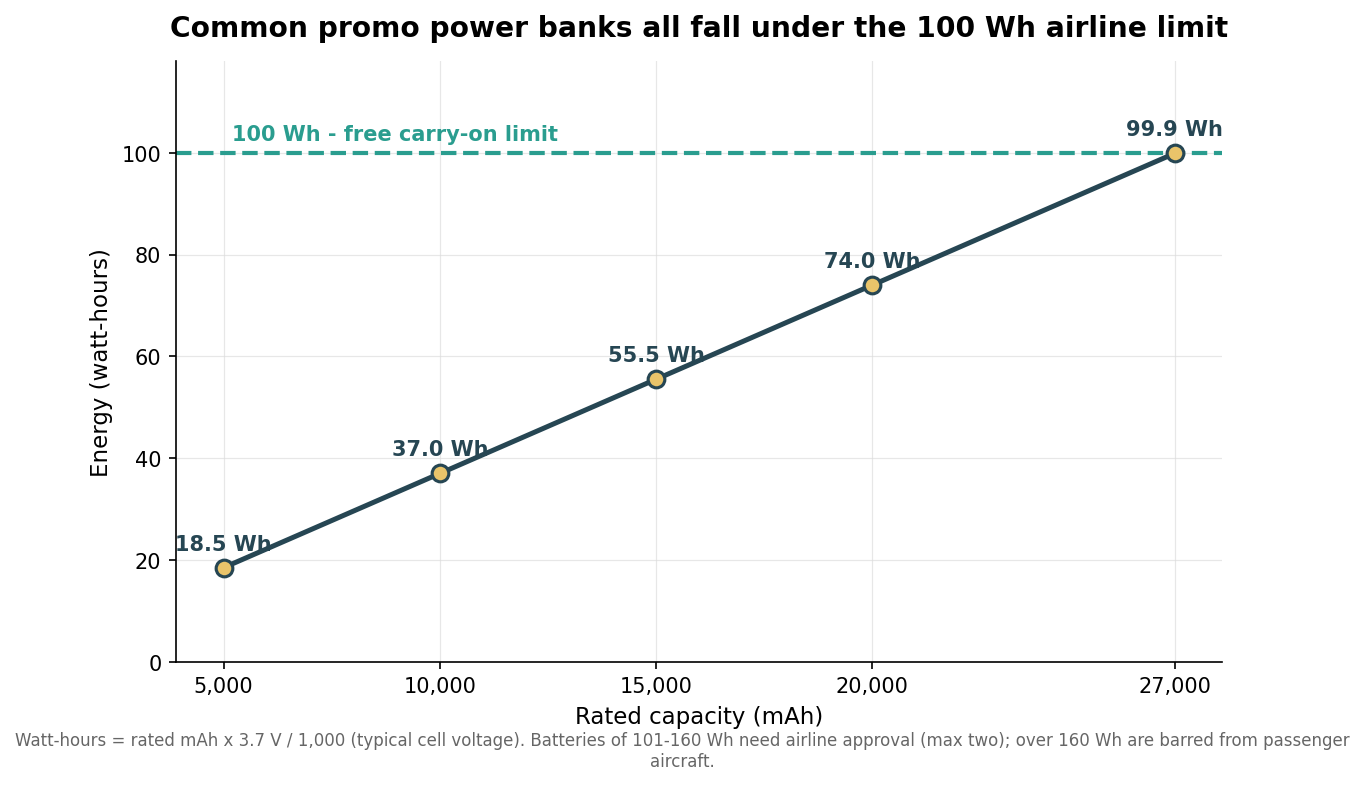
Buyers fixate on milliamp-hours because that is the number printed on the case, but aviation rules are written in watt-hours. The conversion is straightforward: multiply the rated capacity in milliamp-hours by the cell voltage, typically 3.7 volts, then divide by 1,000. A 10,000 mAh bank works out to about 37 Wh, a 20,000 mAh bank to about 74 Wh, and even a large 27,000 mAh unit lands near 99.9 Wh, just under the line.
Nearly all promotional power banks fall well under the 100 Wh threshold airlines allow without approval.
That line matters because current FAA guidance lets passengers freely carry batteries up to 100 Wh in carry-on baggage. From 101 to 160 Wh, a traveler needs the airline’s approval and may bring no more than two spares. Above 160 Wh, the battery is forbidden on passenger aircraft entirely. The practical takeaway for promotional buyers is reassuring: virtually every giveaway-sized power bank, from 5,000 to 20,000 mAh, sits comfortably under 100 Wh, so your recipients can travel with them without special permission. It is only the oversized, high-capacity units that stray into approval territory.
The 2026 in-flight rules your recipients will meet
Handling rules tightened noticeably in 2026, and it is worth knowing so you can set expectations. Under the IATA Dangerous Goods Regulations that took effect on January 1, 2026, charging a power bank from an in-seat USB port or outlet is now prohibited in flight, and power banks may not be used to charge devices during taxi, takeoff, or landing. Individual carriers went further: United Airlines, effective March 1, 2026, barred power banks from overhead bins, requiring that they stay on the passenger, in a seat pocket, or in an under-seat bag where crew can see them, and a number of Emirates, Korean, Japanese, Australian, and European carriers adopted comparable mid-flight restrictions. Across all of it, one rule has never changed and remains the most important: lithium power banks belong in carry-on baggage and must never be packed in checked luggage, because a fire in the hold is far more dangerous than one in the cabin.
Rated capacity is not what comes out of the port
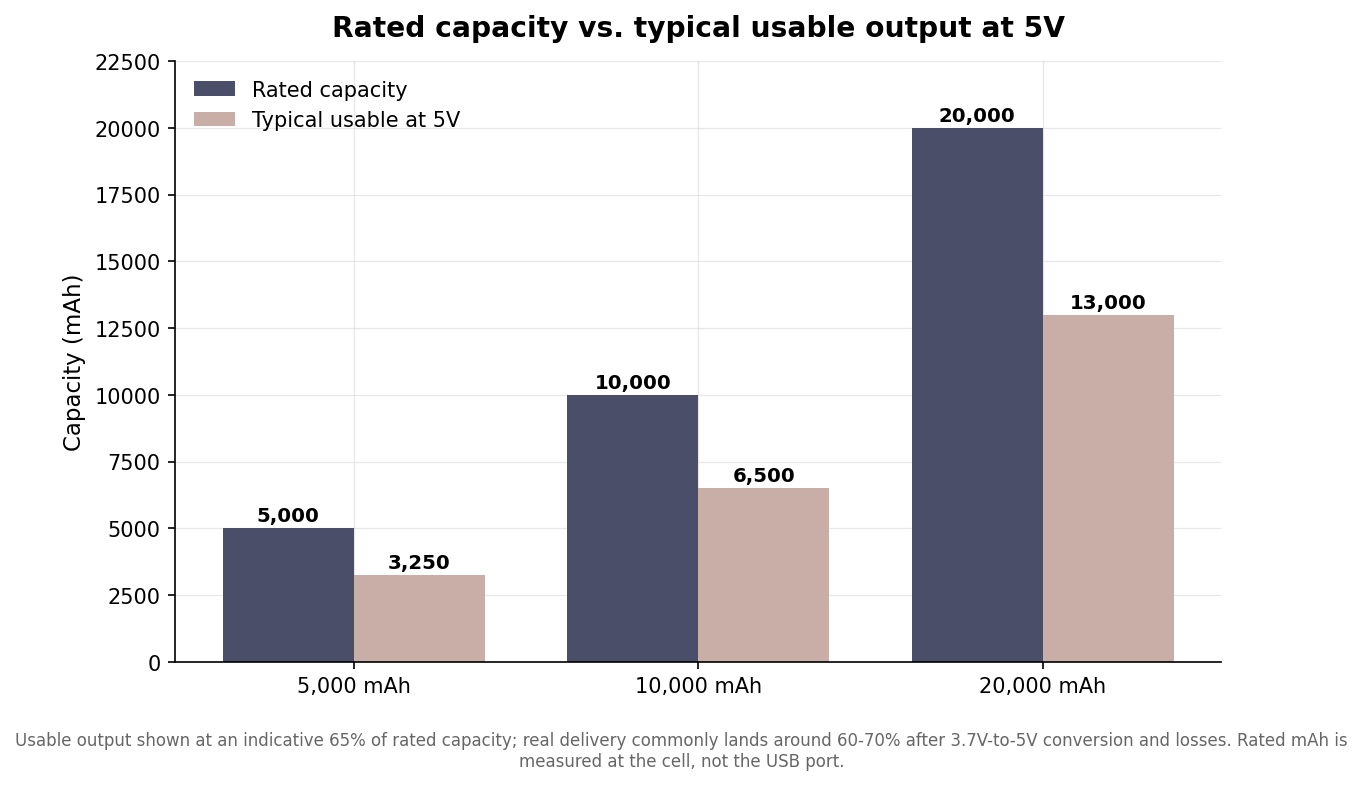
There is an honest gap between the capacity printed on a power bank and the charge it actually delivers, and it is not a defect. The cells inside store energy at roughly 3.7 volts, while the USB output steps up to 5 volts, and that conversion plus normal heat and circuit losses means usable output typically lands somewhere around 60 to 70 percent of the rated figure. A 10,000 mAh bank, in other words, realistically delivers something closer to 6,000 to 7,000 mAh at the port, which is usually a bit under two full charges for a modern phone rather than the two-and-a-half the raw number implies.
Usable output at the USB port typically runs 60 to 70 percent of the rated capacity.
Those percentages are indicative rather than exact, and efficiency varies with the specific unit, the device being charged, and temperature. The reason to understand it is to avoid two traps: overpromising in your own marketing copy, and falling for a supplier quoting an impossibly high capacity in a suspiciously small, light housing. If the rated milliamp-hours seem too generous for the size and weight, they usually are, and inflated capacity claims are one of the most common problems in cheap battery products.
How to verify before you commit
The single best habit is to ask for documentation in writing. Request the UN 38.3 test summary and the relevant safety and market certifications for your destination, and confirm the actual cell capacity rather than accepting only a headline number. Order a pre-production sample and, if you can, weigh it and test how many phone charges it genuinely provides, since a real unit tells you more than any spec sheet. Confirm with your freight forwarder how the batteries will ship, because lithium cells travel under specific packing and labeling rules that add cost and time you want to know about early. A power bank is one of the most useful items you can put a logo on, carried and reached for daily, but that value only holds if the product underneath is safe, legal to move, and honest about what it stores. The paperwork is the part that protects all of it.
Ordering power banks in bulk looks like a commodity purchase right up until the first quote lands and every line reads differently: one supplier wants 100 units, another 500, and the per-piece price swings by a factor of five depending on capacity and imprint. The chargers themselves are a mature product, so the real work of a bulk order is specifying the right combination of capacity, decoration, and shipping method before you commit. Get those three right and the order is boring in the best way. Get them wrong and you learn about lithium-battery paperwork the hard way, usually with a container sitting at a port.
Start with capacity, because it sets your minimum order
Capacity is the first decision because it quietly determines your minimum order quantity and your floor price. Suppliers group promotional power banks into tiers, and each tier carries its own MOQ. A basic 5,000mAh unit typically starts around 50 to 100 pieces. A 10,000mAh model with USB-C Power Delivery generally runs a 100 to 300 piece minimum. Qi wireless models that charge a phone on contact tend to start at 200 to 500 units, and MagSafe-compatible magnetic banks sit at the same 300 to 500 range. A fully custom, tooled-from-scratch design is a different animal and usually needs 1,000 units or more to justify the mold.
For most branded giveaways, a 10,000mAh USB-C bank is the sensible middle. It holds roughly two full phone charges, it is the capacity buyers now expect, and it stays comfortably inside the shipping thresholds discussed below. A 10,000mAh cell at a nominal 3.7 volts is about 37 watt-hours; even a 20,000mAh unit lands near 74 watt-hours, which matters more than it sounds once the freight forwarder gets involved.
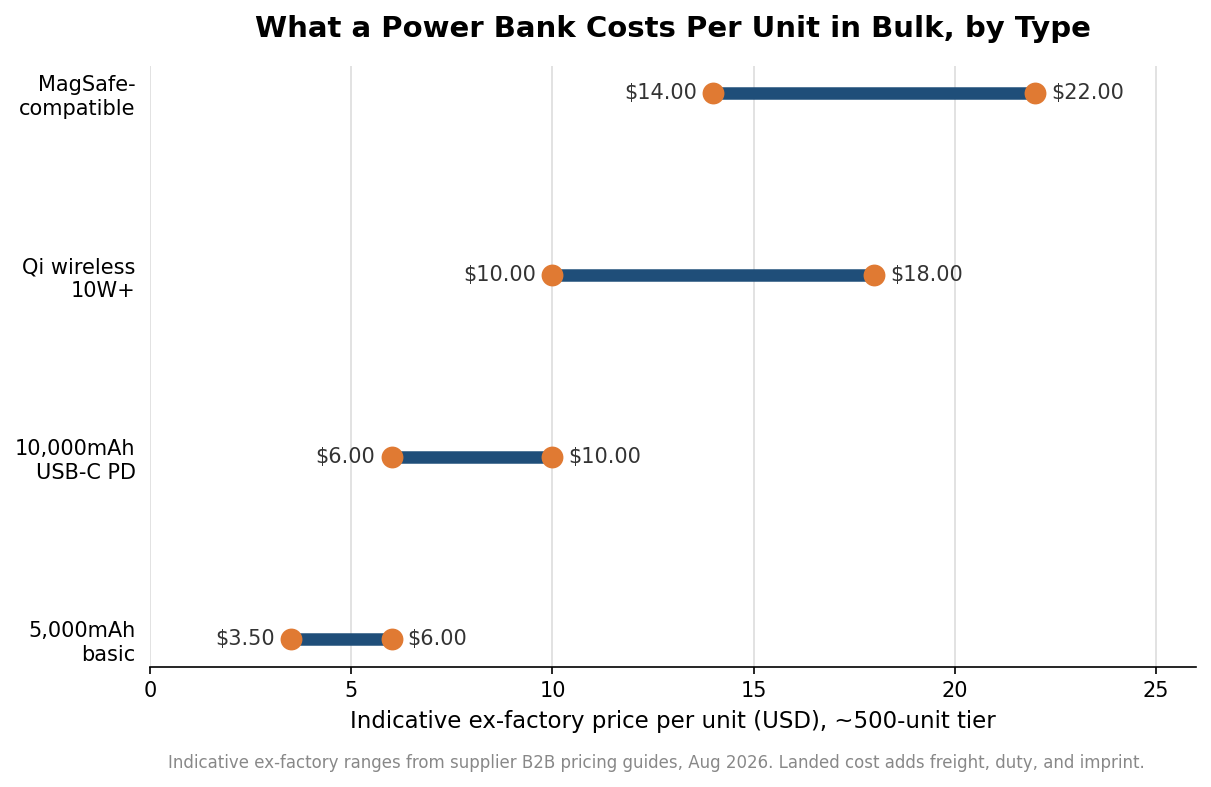
Per-unit factory prices by capacity and type; landed cost adds freight, duty, and imprint.
What quantity actually does to the per-unit price
Bulk pricing is real, but it is not linear, and it flattens faster than buyers expect. Indicative ex-factory pricing at a 500-unit tier runs roughly $3.50 to $6.00 for a 5,000mAh basic bank, $6.00 to $10.00 for a 10,000mAh USB-C model, $10.00 to $18.00 for a Qi wireless unit, and $14.00 to $22.00 for a MagSafe-compatible bank. Those are factory prices for the bare unit; your landed cost adds ocean freight, import duty, and the imprint, so treat them as a floor rather than a delivered figure.
The steepest savings come from clearing the first real MOQ, not from chasing enormous volumes. Moving from a no-minimum sample run to a 500-unit order is where the per-piece cost drops the most; going from 500 to 1,000 shaves a good deal less. If a vendor quotes a single flat price regardless of quantity, ask them to break it out by tier, because a genuine bulk supplier prices in bands. Where a figure like this is a range rather than a firm number, it is because capacity, cell quality, and certification all move the price within it.
Imprint method changes durability, cost, and the minimum
How your logo goes on the case is not a cosmetic afterthought; it interacts with both minimum order and unit cost. Laser engraving is the most durable option because it removes or darkens the surface material rather than sitting on top of it, so it will not scuff off in a bag over months of use. It carries a higher decoration cost and generally needs around 100 units. UV printing reproduces full color and fine gradients, works from about 50 units, and sits in the middle on both price and longevity. Silk screen printing is the cheapest per piece for a simple one or two color mark, but it tends to want a higher run of around 500 units to be worthwhile.
Match the method to the lifespan of the campaign. A conference handout that needs to look sharp for a weekend does not need laser engraving; a device you want employees carrying for two years does. If your brand color has to be exact, UV printing holds a Pantone target more reliably than engraving, which reveals the case material’s own color.
The lithium rules that quietly decide your lead time
Every power bank is a lithium-ion battery, which means it ships as regulated cargo, and two documents govern whether it moves at all. The first is a UN38.3 test report, the battery’s transport passport, confirming it passed a battery of tests including altitude simulation, thermal shock, and vibration. It is mandatory for both air and sea freight. The second is a current Material Safety Data Sheet; freight forwarders and customs brokers will not book space without it, and an out-of-date version is a common reason shipments get rejected.
Watt-hours set the difficulty. Units under 100 watt-hours, which covers essentially all promotional power banks, face lighter handling and can qualify for reduced provisions, while anything over 100 watt-hours becomes fully regulated Class 9 dangerous goods with stricter packaging and higher freight cost. There is also a classification split worth knowing: a bank shipped on its own is UN3480 and draws the most airline scrutiny, while one packed with or inside equipment is UN3481 and moves more easily. Sea freight in a full container load is the standard path for bulk stock; air is reserved for urgent samples through a courier’s dangerous-goods service and costs far more.
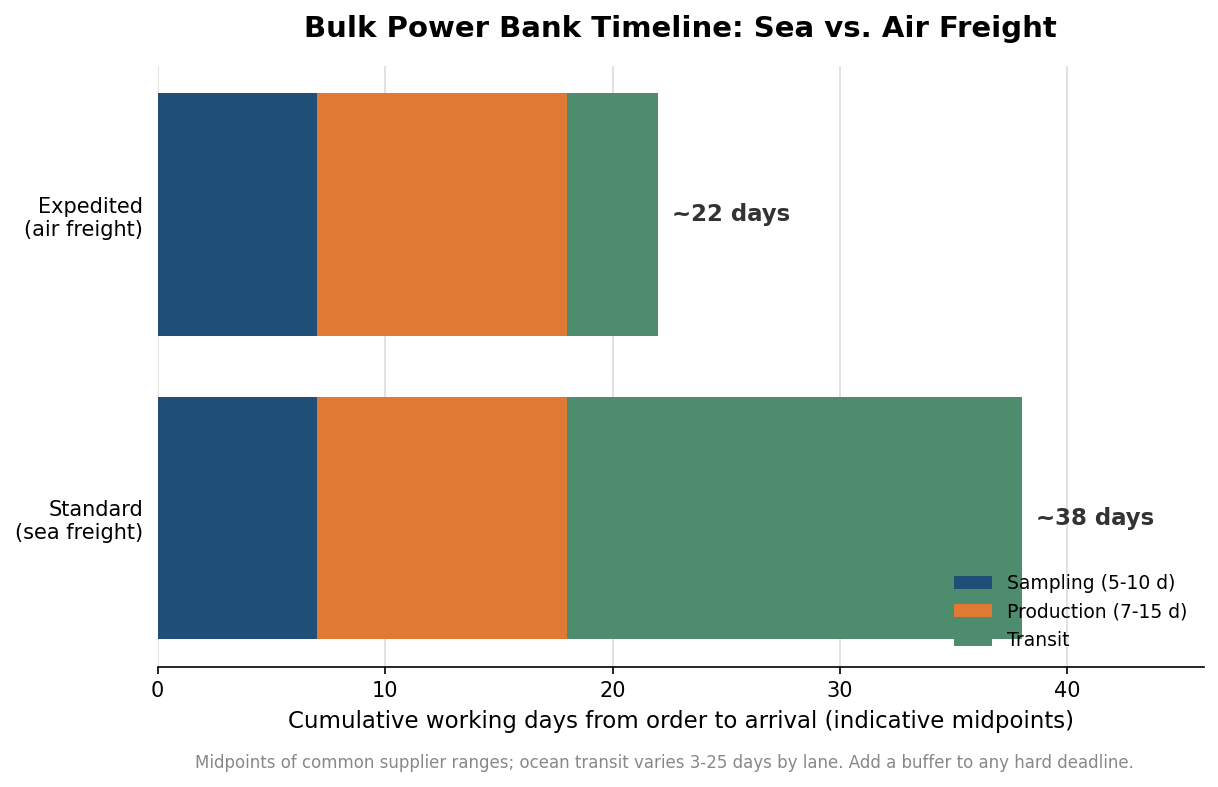
A typical order-to-arrival timeline for sea versus air freight, using midpoint durations.
Building a timeline you can actually promise
Put the pieces together and a realistic schedule emerges. Sampling runs about 5 to 10 days, mass production another 7 to 15 depending on capacity, and ocean transit anywhere from 3 to 25 days by lane. That is why suppliers advise starting at least eight weeks ahead of any hard date such as a trade show, and the buffer exists precisely because the lithium paperwork and customs clearance are the least predictable stretch. If your event is closer than that, expedited air freight can compress the transit leg dramatically, but it raises both the freight bill and the compliance overhead, so it is a rescue plan rather than a default. Order the samples early, confirm the UN38.3 report and MSDS are in hand before production finishes, and the rest of a bulk power bank order tends to run on rails.
How to Choose Custom Power Banks for Your Brand: Use Cases and Ordering
The best way to choose custom power banks is to start from how they will be used, then work back to the material, size, and decoration that fit. Custom power banks serve very different jobs across trade shows & events, corporate gifting, retail & promotions, and fundraisers & teams, and matching the order to the job is what makes custom power banks feel purpose-built rather than generic. This guide maps the common use cases and walks through ordering custom power banks that fit your brand.
Whether the power banks protects a product, presents a gift, or carries a logo into the world, defining that job first keeps every later decision easy. Purpose drives the spec, and the spec drives the result.
How brands use custom power banks
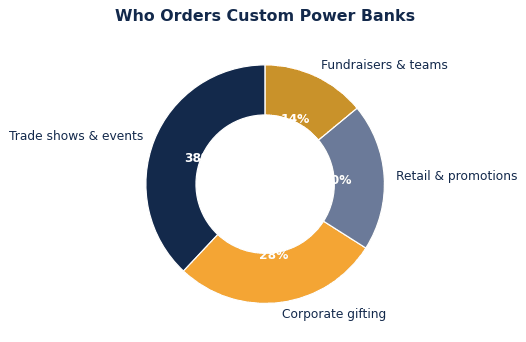
Custom power banks get ordered for a mix of protection, presentation, and promotion, and knowing where yours fall points you to the right build. The breakdown below shows the common uses, from trade shows & events to fundraisers & teams.
The common ways brands put custom power banks to work.
Most orders lean toward one primary job with a secondary benefit — a shipping-focused power banks that also brands the unboxing, or a gift-focused one that also protects. Naming your primary use keeps the order focused and the spec appropriate.
Use case
What it needs
Trade shows & events
memorable swag that gets picked up and kept
Corporate gifting
branded items clients and staff actually use
Retail & promotions
impulse items that carry a logo home
Fundraisers & teams
affordable branded pieces for a crowd
Matching material and size to the use
Once the use is clear, the material and size follow. A protection-first job favors a durable, well-fitted build; a presentation-first job favors a premium material and a clean print; a promotion-first job favors a cost-effective option you can order in volume. Sizing to the product with a small margin keeps the power banks looking intentional and performing its job.
If a single order serves more than one use, spec to the most demanding one so the power banks performs everywhere. It is easier to use a slightly sturdier or more premium power banks across the board than to discover a bargain option falls short for your most important use case.
Branding for the impression you want
Decoration should reinforce the impression the use calls for. Pad printing and full-color wraps place logos vividly, with engraving or embossing for an upscale, permanent mark. For a premium or gift use, lean on finishes and restraint; for high-volume promotion, prioritize a bold, legible logo that reads at a glance and reproduces affordably at scale. Keep branding consistent with the rest of your packaging or merch so everything reads as one system.
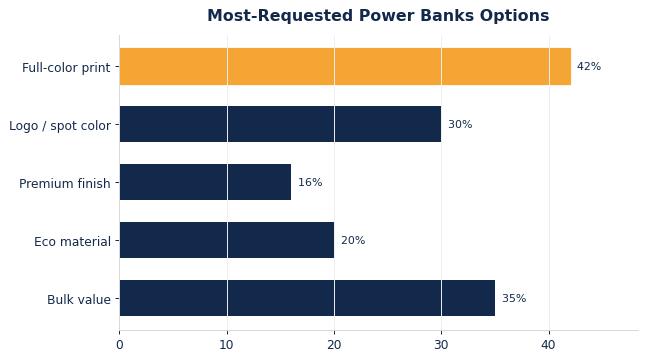
The most-requested options below reflect what buyers reach for most, and they are a useful starting menu when you brief your order. Whatever you choose, approve a proof so the finished custom power banks match the impression you intended.
The options buyers request most on custom power banks.
Getting the size and details right
Even with the use and material decided, the details are what make custom power banks feel finished. Confirm the size and format against the product with a small margin, check the print area for your chosen size so the logo sits cleanly, and decide on any finishing touches before you brief the order. These small confirmations up front are what separate a power banks that looks intentional from one that looks close-enough.
A sample or proof is the cheapest insurance you can buy on a power banks order. A physical sample lets you judge the material and print in hand, while a digital proof confirms artwork, color, and size and format before the full run. Spending a few minutes here prevents the far larger cost of reworking a finished order of custom power banks that missed on a detail.
Ordering: quantities, lead time, and reorders
A smooth power banks order comes down to a few basics: order for real demand plus a small overage, send print-ready artwork early, and confirm lead time against any deadline so production and shipping fit your timeline. Per-unit cost drops with volume, so consolidating a season’s needs into one run is usually more efficient than repeated small orders.
Keep your approved artwork and spec on file so reorders are a quick repeat rather than a fresh setup each time — consistency across runs keeps your brand looking deliberate.
Coordinating with the rest of your brand
Custom power banks rarely stand alone; they sit alongside your other packaging, print, or merch, so coordinating them strengthens the whole brand. Carrying the same logo, colors, and tone across your power banks and your other pieces makes everything read as one deliberate system rather than a set of one-off orders. That consistency is what makes a brand feel established, and it costs nothing extra to plan.
Coordination also simplifies buying over time. Standardizing on a material, size, and decoration you are happy with turns future orders into simple repeats, and it keeps every batch matching the last. A little upfront alignment pays back every time you reorder custom power banks.
Frequently asked questions about custom power banks
What are custom power banks used for?
Custom power banks serve a mix of protection, presentation, and promotion across trade shows & events, corporate gifting, retail & promotions, and fundraisers & teams. Most orders lean toward one primary job with a secondary benefit, so naming your main use is the first step in speccing the right power banks.
How do I match custom power banks to my use?
Let the use drive the spec: durable and well-fitted for protection, premium and clean for presentation, cost-effective and bold for promotion. If one order serves several uses, spec to the most demanding one so the power banks performs everywhere.
How should I brand custom power banks?
Pad printing and full-color wraps place logos vividly, with engraving or embossing for an upscale, permanent mark. Choose finishes and restraint for premium or gift uses, and a bold, legible logo for high-volume promotion, keeping the branding consistent with your other packaging or merch so it all reads as one system.
How far ahead should I order custom power banks?
Order for real demand plus a small overage, send print-ready artwork early, and confirm lead time against any deadline so production and shipping fit your timeline. Consolidating a season’s needs into one run is usually more efficient than repeated small orders.
Can I reorder easily?
Yes. Keeping your approved artwork and spec on file makes reorders a quick repeat rather than a fresh setup, and it keeps every batch of custom power banks matching the last for a consistent brand look.
Do I need a sample before ordering custom power banks?
A sample is worth it for a first order or a new material, since judging feel and print in hand removes the guesswork. For a straightforward reorder of custom power banks you have bought before, a digital proof confirming artwork and size and format is usually enough.
Match the power banks to the job, spec it deliberately, and approve a proof, and your order will do exactly what you needed. For the full material and sizing breakdown, see our companion guide, our Custom Power Banks: Materials, Sizing & Branding Guide, and browse our our shop to get started.
Not sure which custom power banks fit your use?
Tell us how you’ll use them and we’ll match the material, size, and branding to the job.
Custom Power Banks: A Materials, Sizing, and Branding Guide
Getting custom power banks right comes down to three decisions: the material, the size or spec, and how you brand them. Make those well and you end up with custom power banks that protect and present your product, reinforce your brand, and land on budget. This guide walks through the material options, how to size and spec your order, and how to decorate custom power banks so they do real work for your brand rather than just checking a box.
Whether you are ordering your first run or reordering at scale, the same fundamentals apply. Choosing custom power banks deliberately — material to job, size to product, decoration to brand — is what separates an order you are proud of from one you settle for.
Why custom power banks matter for your brand
Custom power banks are more than a commodity; they are a touchpoint brands experience directly. A well-chosen, well-branded option signals quality and attention to detail, while a generic one quietly undercuts an otherwise strong product. Because custom power banks are seen and handled, they carry your brand into the world every time they are used.
That visibility is exactly why it pays to spec custom power banks intentionally. The material sets the feel, the size sets the fit and cost, and the decoration sets the impression — and getting all three aligned turns a functional item into a genuine brand asset.
Materials and options compared
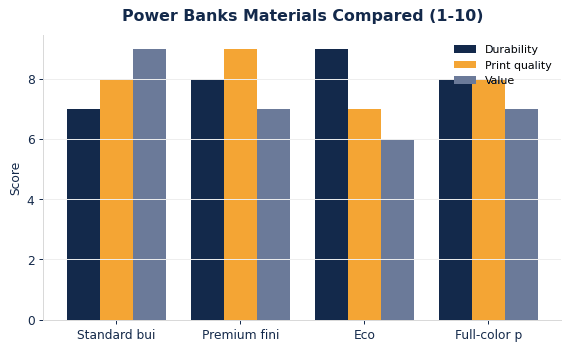
The common materials for custom power banks each trade off durability, print quality, and cost: standard build, premium finish, eco / recycled, and full-color print surface. The right pick depends on how the power banks will be used, the look you want, and your budget. The chart and table below compare the main options so you can match material to job.
How common power banks materials compare on durability, print quality, and value.
As a rule of thumb, choose a recyclable or natural material when eco positioning matters, a coated or laminated option when you want vivid full-color print, and a premium build when the power banks is part of a gift or high-end presentation. When in doubt, request a sample so you can judge feel and print before committing to a full run.
Material / option
Best for
Standard build
reliable, cost-effective for high-volume swag
Premium finish
soft-touch or upgraded feel for gifting
Eco / recycled
sustainable option that signals brand values
Full-color print surface
vivid, edge-to-edge branding area
Sizing and specs
Sizing is where many power banks orders go wrong, so measure before you order. Custom power banks typically range from a compact giveaway up to a larger statement piece, and the right size and format depends on the product or use they serve. Too small and the fit is tight or the product is exposed; too large and you pay for material you do not need and lose a clean, intentional look.
When a measurement falls between standard options, size to the product with a small margin rather than guessing. Confirming the size and format on a proof or sample before a large run prevents the costly mistake of a full order that does not fit, which is far more expensive to fix than a five-minute check up front.
Branding and decoration
Decoration is what turns a plain power banks into a branded one. Pad printing and full-color wraps place logos vividly, with engraving or embossing for an upscale, permanent mark. Match the method to your artwork and budget: simple logos reproduce cleanly and cheaply, while detailed, full-color designs shine with the right process on the right material. Keep the artwork vector where possible and confirm the print area for your chosen size.
Restraint usually reads as premium. A clean logo, one or two brand colors, and quality material almost always look more considered than a busy, over-printed design. Approving a proof before the run protects both the look and the budget, especially on a large order of custom power banks.
Ordering and budget
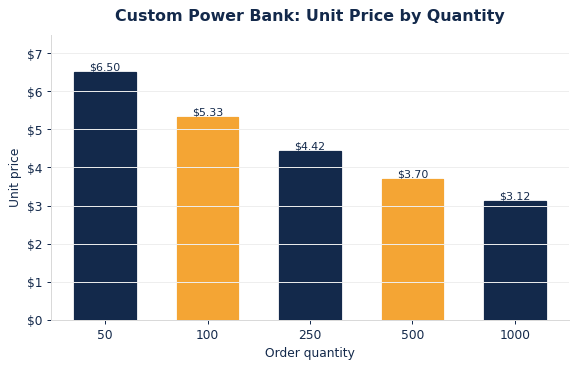
Per-unit cost on custom power banks falls steadily with volume as setup amortizes across more pieces, so ordering for real demand rather than a token first batch is usually the efficient move. The curve below shows how pricing typically improves with quantity, which helps you plan an order that balances cash and cost.
Typical per-unit power banks pricing as order quantity increases.
Ordering for a recurring need? A single larger run lowers the unit cost and keeps your branding consistent, while a small overage covers reorders and the occasional damaged piece without a rush order.
Common mistakes to avoid
A few avoidable missteps account for most disappointing power banks orders. Ordering before measuring is the biggest, followed by choosing a material for price alone without considering how the power banks will actually be used, and skipping the proof on a large run. Each is easy to prevent with a few minutes of planning, and each is expensive to fix once a full order is produced.
The other common trap is over-designing the artwork. Cramming in too many colors, effects, or details can muddy the print and raise the cost, especially on textured or recycled materials. Simplifying the design to a clean, legible mark almost always improves both the look and the price of your custom power banks.
Frequently asked questions about custom power banks
What material is best for custom power banks?
It depends on the use: choose a recyclable or natural material for eco positioning, a coated or laminated option for vivid full-color print, and a premium build for gifting or high-end presentation. Request a sample to judge feel and print before a full run of custom power banks.
How do I choose the right size?
Measure the product or use the power banks serves, then size to it with a small margin so the fit is clean without wasting material. When a measurement falls between standard options, size up slightly and confirm the size and format on a proof before ordering in volume.
How are custom power banks branded?
Pad printing and full-color wraps place logos vividly, with engraving or embossing for an upscale, permanent mark. Match the method to your artwork and budget, keep the art vector where possible, confirm the print area for your size, and approve a proof so the finished custom power banks match your intent.
How does pricing work, and is there a minimum?
Per-unit cost drops with quantity as setup amortizes across the run, so larger orders are more cost-effective. Order for real demand plus a small overage rather than a token batch, and consolidate recurring needs into one run for the best price.
Can I get a sample or proof before ordering?
Yes, and it is strongly recommended. A physical sample lets you judge material and print, and a digital or physical proof confirms your artwork, color, and size and format before a full run — a small step that prevents a costly mistake on a large order.
What do you need to quote custom power banks?
To quote accurately we need the size and format or the product they serve, the quantity, your material preference, and your artwork or a description of the branding. With those details we can recommend the right material and size and give you pricing for the run, and a proof follows once the order is confirmed.
Whatever you order, send vector artwork, confirm material and size and format, and approve a proof before production. For help matching custom power banks to a specific use, see our companion guide, our How to Choose Custom Power Banks for Your Brand, and explore our our shop to start your order.
Ready to order custom power banks?
Tell us your product, quantity, and branding and we’ll match the material, size, and decoration for you.
Home › Blog › A Tech Company's Guide to Power Bank Swag Margins
Margins
A Tech Company's Guide to Power Bank Swag Margins
06/30/2026
Marketing and people-ops teams at tech and SaaS companies often price a branded power bank as a pure cost center — a line item in the swag budget with no return attached. That framing misses how the item actually performs compared to the rest of a typical swag closet: highest daily-use rate, longest visible lifespan, and a real cost-per-impression that beats almost everything else you could buy.
Here’s how to think about the economics before your next order.
Cost per impression, not just cost per unit
A branded power bank gets pulled out of a bag every time someone’s phone dies — often multiple times a week for a heavy phone user — and each pull is a fresh look at your logo, frequently in a shared space like an office, coffee shop, or classroom. Compare that to a t-shirt worn a handful of times a year, or a pen that gets lost within a month, and the cost-per-impression math favors the power bank even at a higher unit price.
Typical volume pricing
Order size
Typical per-unit range*
100
$18–$22
500
$13–$18
2,000
$10–$14
5,000+
$8–$11
*Estimates only, illustrative of typical volume pricing — request a quote for your exact specs and style.
Where the budget conversation goes wrong
The most common mistake is comparing a power bank’s unit cost directly against a cheap giveaway like a sticker or lanyard, then concluding it’s “too expensive” for a mass giveaway. The better comparison is against your cost of customer acquisition or your recruiting cost-per-hire — a $12 power bank that a candidate keeps for two years and shows to colleagues is cheap relative to either number.
Setting your program budget
A simple rule of thumb for tech and SaaS teams: reserve your higher-capacity or wireless-charging models for high-value touchpoints (investor meetings, executive onboarding, key accounts) where the per-unit cost is easily justified, and use the 5000mAh Slim model for high-volume touchpoints (conferences, general onboarding, referral gifts) where the lower price point lets the budget stretch further.
Key takeawayJudge power bank swag on cost-per-impression against acquisition or hiring costs, not against cheap giveaways — and split your budget between a high-volume style and a premium style by touchpoint.
Home › Blog › How to Order Custom Power Banks: A Step-by-Step Checklist
Ordering
How to Order Custom Power Banks: A Step-by-Step Checklist
06/01/2026
Ordering a custom power bank for the first time involves a handful of decisions that are easy to make quickly once you know what to have ready. This checklist walks through the process in the order we actually need the information, from first quote request to delivery.
1. Gather your artwork
Have your logo ready as a vector file (AI, EPS, SVG, or PDF) if possible. If you only have a PNG or a photo of your logo, that’s fine too — our designers will recreate it print-ready at no charge.
2. Decide on quantity
An exact number isn’t necessary at the quote stage — an estimate is enough to get accurate bulk pricing. Our minimum is 12 units, and pricing improves at higher volumes, so it’s worth telling us if you’re flexible on quantity.
3. Pick a style and capacity
Choose from our five styles based on your use case — the 5000mAh Slim for high-volume giveaways, the 10000mAh for a more substantial gift, Wireless Charging for VIP tiers, the Cable Gift Set for a complete unboxing, or Rugged Outdoor for field and event use. Not sure? Tell us your audience and we’ll recommend one.
4. Choose a color and decoration method
Pick from Matte black, White, Navy, or a custom Pantone-matched print, and decide between UV printing (full color) or laser engraving (permanent, single tone).
5. Submit your quote request
Send your artwork, estimated quantity, style, and color preference through our quote form. We reply within one business day with a photo-real mockup and bulk pricing.
6. Review and revise your mockup
Review the mockup for logo placement, color accuracy, and sizing. Revisions are free and unlimited — take as many rounds as you need until it’s right.
7. Approve and pay
Once you sign off on the final mockup, we lock the design and begin production the same day.
8. Production & shipping
Standard production takes about 3 weeks from approval. Rush timelines are available if you’re working against a fixed event date — ask when you submit your quote.
Step
Typical timing
Quote & mockup
1 business day
Revisions
As needed, free
Approval to production start
Same day
Production & shipping
~3 weeks
Key takeawayHave your logo and a rough quantity ready, and the path from quote to delivery is predictable: one business day to a mockup, unlimited free revisions, and about 3 weeks to ship after approval.
Home › Blog › UV Print vs. Laser Engraving: Which Logo Lasts Longer on a Power Bank
Durability
UV Print vs. Laser Engraving: Which Logo Lasts Longer on a Power Bank
05/10/2026
A power bank spends its life getting tossed into bags, dropped on desks, and jostled against keys and chargers — more daily wear than most branded merchandise sees. Choosing a decoration method that can survive that environment matters more here than it does on, say, a tote bag.
Both of our methods are built to last, but they hold up differently, and the right pick depends on your logo and how the item will be carried.
How each method is applied
UV printing cures full-color ink directly onto the ABS shell using ultraviolet light, bonding it into the surface rather than sitting on top like a sticker. Laser engraving uses a focused laser to etch the design into the shell material itself, removing a thin layer of the surface to create a permanent, tactile mark.
Durability side by side
Factor
UV Print
Laser Engraving
Color capability
Full color, gradients
Single tone (shell color shows through)
Resistance to scuffing
Very good — bonded, not surface-level
Excellent — etched into the material
Resistance to fading
Good with standard use
Permanent, will not fade
Feel
Smooth, flush with surface
Slightly textured, tactile
Best for
Multi-color logos, bold branding
Single-color marks, premium feel
Which one actually lasts longer
In practical terms, both methods are built to outlast the useful life of the power bank itself under normal daily handling. Laser engraving has a slight edge in raw permanence since there’s no ink layer to wear at all — the mark is the material. UV print is not far behind for typical bag-and-desk use, and it’s the only option if your logo relies on multiple colors or a gradient, since engraving renders everything in a single tone.
Choosing for your order
If your logo is a single color or a simple wordmark, laser engraving gives you the most durable, premium-feeling result. If your logo depends on color — a gradient, a multi-color mark, or brand colors that need to read accurately — UV print is the only way to reproduce it faithfully, and it holds up extremely well to daily carry regardless.
Key takeawayLaser engraving is the most permanent option for single-color logos; UV print is the only way to reproduce full-color branding, and both hold up to daily bag wear.
Home › Blog › Custom Power Banks for Universities & Student Orgs
Universities
Custom Power Banks for Universities & Student Orgs
04/19/2026
Of all the swag options a university department or student organization can hand out, a power bank solves a problem students actually have on a daily basis: a dead phone between classes, at a football game, or during a late library session. That practical value is why it consistently outperforms generic giveaways at orientation and campus events.
Here’s how campus buyers typically plan and budget for a power bank program.
Where power banks fit on a campus calendar
Orientation week is the biggest single event most schools run, often needing 500–2,000 units for a single incoming class. Beyond orientation, student government, Greek life chapters, and club sports teams order smaller batches of 100–300 for tabling events, recruitment drives, and homecoming weekend.
Budgeting on a student org timeline
Most student orgs and university departments work with fixed annual budgets set months in advance, so our 3-week production window is easy to plan around as long as the order goes in ahead of the event date, not the week before. We recommend locking in artwork and quantity at least 5 weeks out to leave room for a mockup round and any budget approval delays on the school’s side.
Campus use case
Typical quantity
Recommended style
Freshman orientation
500–2,000
5000mAh Slim Power Bank
Student org tabling
100–300
5000mAh Slim Power Bank
Fundraising / raffle prize
50–150
10000mAh Power Bank
Athletics / homecoming
300–1,000
Rugged Outdoor Power Bank
Getting the branding right
Most campus orders use school colors and a Pantone-matched print of the university seal or mascot, since students respond to spirit-marked items far more than a plain department logo. We can also personalize a small batch with a graduation year or event name for senior class gifts or reunion giveaways.
Choosing for your order
If you’re ordering for a single big event, the 5000mAh Slim model keeps cost manageable at high volume. If the program is smaller and gift-like — a scholarship recognition or raffle prize — the 10000mAh model reads as a more considered gift for the budget.
Key takeawayLock artwork and quantity at least 5 weeks before your event date, and match volume-heavy orientation orders to the 5000mAh Slim model.