A branded power bank is a battery first and a marketing item second, and batteries are regulated the world over. That single fact changes how you should buy one. A T-shirt that fails to impress is a waste of money; a power bank that lacks the right paperwork can be blocked from air freight, held at customs, or taken from your recipient at an airport gate. None of that shows up in a product photo, so the compliance questions are the ones worth asking before you place the order, not after the pallet is sitting on a dock.
The certifications that actually matter
Several marks get thrown around, and they are not interchangeable. UN 38.3 is the one you cannot skip: it is a United Nations transport-safety test that every lithium battery must pass to move legally by air, sea, or road. It subjects cells to altitude simulation, thermal cycling, vibration, shock, external short circuit, impact, overcharge, and forced discharge. Without a UN 38.3 test report, a freight forwarder should refuse the shipment, so ask for it by name.
UL 2056 is the North American safety standard written specifically for power banks, covering overcharge and over-discharge protection, short-circuit response, overload handling, drop resistance, and temperature behavior. Worth knowing: it functions as a testing standard, so a compliant unit will not always carry a visible UL mark, and you may need to request the test report rather than look for a logo. Beyond those two, CE covers sale into the European Union, FCC covers electromagnetic interference for the United States, and RoHS restricts hazardous substances such as lead and cadmium. Sell into other markets and the list grows: PSE for Japan, KC for South Korea, CCC for mainland China. You do not need every mark for every order, but you do need the ones that match where the product will ship and where it will be used.
Watt-hours, not milliamp-hours, are what airlines check
Buyers fixate on milliamp-hours because that is the number printed on the case, but aviation rules are written in watt-hours. The conversion is straightforward: multiply the rated capacity in milliamp-hours by the cell voltage, typically 3.7 volts, then divide by 1,000. A 10,000 mAh bank works out to about 37 Wh, a 20,000 mAh bank to about 74 Wh, and even a large 27,000 mAh unit lands near 99.9 Wh, just under the line.
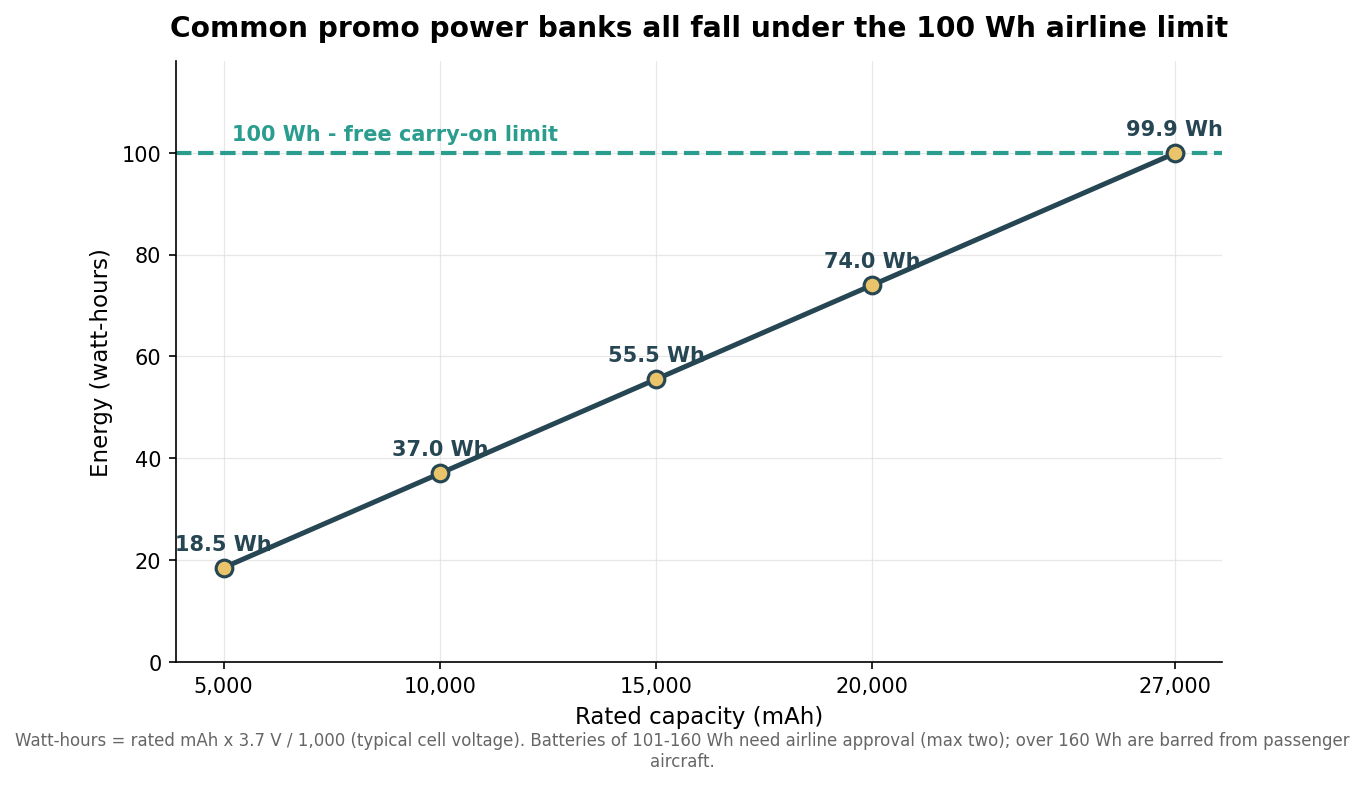
That line matters because current FAA guidance lets passengers freely carry batteries up to 100 Wh in carry-on baggage. From 101 to 160 Wh, a traveler needs the airline’s approval and may bring no more than two spares. Above 160 Wh, the battery is forbidden on passenger aircraft entirely. The practical takeaway for promotional buyers is reassuring: virtually every giveaway-sized power bank, from 5,000 to 20,000 mAh, sits comfortably under 100 Wh, so your recipients can travel with them without special permission. It is only the oversized, high-capacity units that stray into approval territory.
The 2026 in-flight rules your recipients will meet
Handling rules tightened noticeably in 2026, and it is worth knowing so you can set expectations. Under the IATA Dangerous Goods Regulations that took effect on January 1, 2026, charging a power bank from an in-seat USB port or outlet is now prohibited in flight, and power banks may not be used to charge devices during taxi, takeoff, or landing. Individual carriers went further: United Airlines, effective March 1, 2026, barred power banks from overhead bins, requiring that they stay on the passenger, in a seat pocket, or in an under-seat bag where crew can see them, and a number of Emirates, Korean, Japanese, Australian, and European carriers adopted comparable mid-flight restrictions. Across all of it, one rule has never changed and remains the most important: lithium power banks belong in carry-on baggage and must never be packed in checked luggage, because a fire in the hold is far more dangerous than one in the cabin.
Rated capacity is not what comes out of the port
There is an honest gap between the capacity printed on a power bank and the charge it actually delivers, and it is not a defect. The cells inside store energy at roughly 3.7 volts, while the USB output steps up to 5 volts, and that conversion plus normal heat and circuit losses means usable output typically lands somewhere around 60 to 70 percent of the rated figure. A 10,000 mAh bank, in other words, realistically delivers something closer to 6,000 to 7,000 mAh at the port, which is usually a bit under two full charges for a modern phone rather than the two-and-a-half the raw number implies.
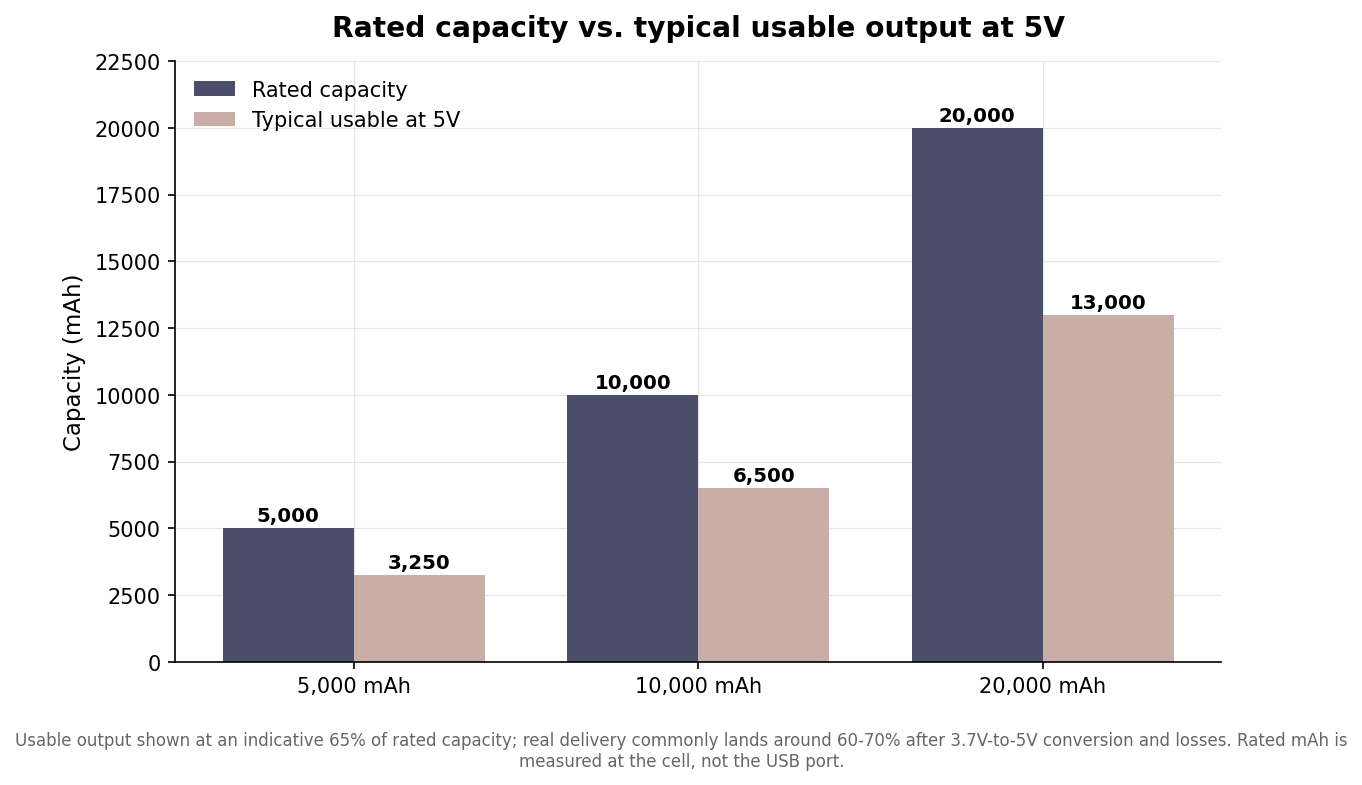
Those percentages are indicative rather than exact, and efficiency varies with the specific unit, the device being charged, and temperature. The reason to understand it is to avoid two traps: overpromising in your own marketing copy, and falling for a supplier quoting an impossibly high capacity in a suspiciously small, light housing. If the rated milliamp-hours seem too generous for the size and weight, they usually are, and inflated capacity claims are one of the most common problems in cheap battery products.
How to verify before you commit
The single best habit is to ask for documentation in writing. Request the UN 38.3 test summary and the relevant safety and market certifications for your destination, and confirm the actual cell capacity rather than accepting only a headline number. Order a pre-production sample and, if you can, weigh it and test how many phone charges it genuinely provides, since a real unit tells you more than any spec sheet. Confirm with your freight forwarder how the batteries will ship, because lithium cells travel under specific packing and labeling rules that add cost and time you want to know about early. A power bank is one of the most useful items you can put a logo on, carried and reached for daily, but that value only holds if the product underneath is safe, legal to move, and honest about what it stores. The paperwork is the part that protects all of it.
Leave a Reply