A branded power bank is one of the most genuinely useful gifts a company can hand out, which is exactly why it so often travels. Recipients throw it in a carry-on for a conference, a sales trip, or a holiday, and that is the moment airline battery rules come into play. Those rules tightened noticeably through 2025, and a gift that cannot clear security or that a flight attendant makes someone stow away is a poor advertisement. The good news is that the regulations are clear and that almost every promotional-sized power bank is well within them, provided you understand the one number that governs everything.
Watt-hours, not milliamp-hours, are what the rules measure
Airlines and aviation regulators do not limit power banks by the milliamp-hour figure printed on the front. They limit them by energy, measured in watt-hours, because watt-hours reflect how much energy could be released in a fault. The conversion is simple: take the capacity in milliamp-hours, divide by 1,000 to get amp-hours, and multiply by the cell voltage, which for the lithium cells inside almost every power bank is a nominal 3.7 volts. A 10,000 mAh bank is therefore about 37 watt-hours, and a 20,000 mAh bank about 74 watt-hours. The regulatory ceiling that matters most, 100 watt-hours, works out to roughly 27,000 mAh, which is larger than the vast majority of promotional units.
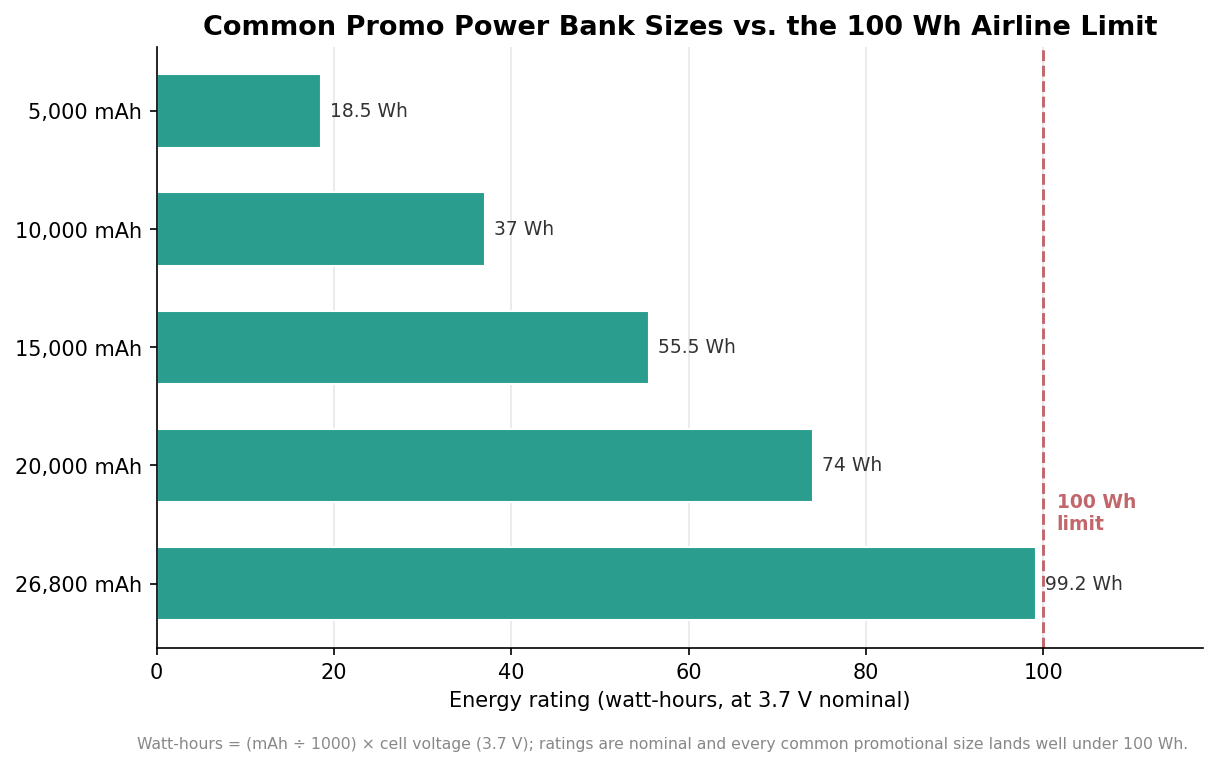
The practical consequence is reassuring for anyone ordering swag. The popular gifting capacities, from a slim 5,000 mAh up to a substantial 20,000 mAh, all sit comfortably under the 100 watt-hour line, so they need no special permission and travel as ordinary carry-on items. It is only when a bank pushes toward 26,800 or 27,000 mAh that it approaches the threshold, and a few oversized units climb past it.
The three capacity zones
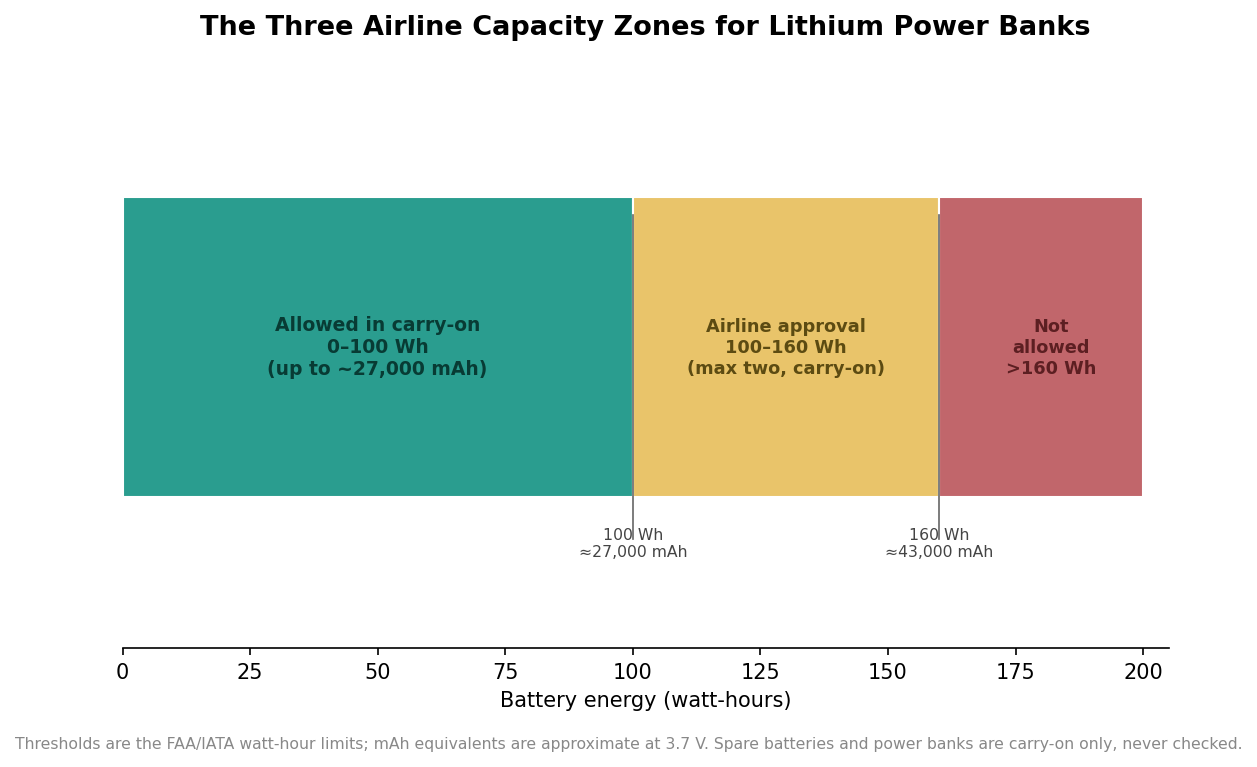
The rules sort lithium power banks into three bands. Anything up to 100 watt-hours is allowed without approval and is the zone every sensible promotional product should live in. From 100 to 160 watt-hours, a bank is permitted only with the airline’s advance approval, and passengers may carry a maximum of two such batteries. Above 160 watt-hours, which corresponds to roughly 43,000 mAh, spare batteries and power banks are simply prohibited from passenger aircraft. One rule spans all three bands and catches people out constantly: power banks and spare batteries must travel in carry-on baggage and are forbidden in checked luggage, because a fire in the hold is far harder to fight than one in the cabin.
Carry-on only, and the short-circuit rule
The carry-on requirement is worth restating because it is the rule travelers break most often by habit. A power bank tucked into a checked suitcase is not a minor infraction; spare lithium batteries and power banks are forbidden in the hold outright, because cabin crew can respond to a fire they can see and reach. Alongside that, regulators require spare batteries to be protected from damage and short circuit, which in practice means keeping a power bank away from keys, coins, and loose metal that could bridge its ports. For a promotional unit this is a small design point with real value: a recessed or capped USB port, a hard shell rather than a bare cell, and a housing that survives being knocked around a bag all make the gift both safer and more likely to keep working. It is a reminder that build quality and compliance are the same conversation, not two separate ones.
The 2025 change: keep it in reach and don’t charge it in flight
The newer wrinkle is not about capacity at all but about how a power bank is stored and used during the flight. After a series of in-cabin battery fires, including incidents on Air China and Air Busan flights and a run of lithium battery events across US aviation in 2025, a large group of carriers changed their in-flight rules. The Lufthansa group of airlines, along with Southwest, Qantas, Emirates, Singapore Airlines, Cathay Pacific, Korean Air, Thai Airways and others, now variously prohibit using or charging a power bank in flight and require that it be kept within reach, under the seat in front or in the seat pocket, rather than in an overhead bin where a fault could smolder unseen. The exact wording differs by airline and continues to evolve, so the honest guidance to pass along with a gift is to keep the power bank accessible, avoid charging from it during the flight where prohibited, and check the specific airline’s current policy before flying.
What to specify for a power bank that travels well
For a corporate gift, the design brief writes itself once the rules are clear. Choose a capacity in the everyday range, roughly 5,000 to 20,000 mAh, which keeps the unit far below the 100 watt-hour limit and out of the approval bracket entirely; a 10,000 mAh unit around 37 watt-hours is a common sweet spot that charges most phones once or twice while staying pocketable. Insist that the supplier’s cells carry the standard lithium transport testing, commonly referenced as UN38.3, and that the finished unit shows its watt-hour or capacity rating clearly on the housing, because a bank with no legible rating is the one most likely to be questioned at a checkpoint. Steer clear of very high-capacity 30,000 mAh-plus units for broad giveaways, since those are the ones that flirt with or cross the approval line.
None of this should discourage a power bank as a gift; it argues for choosing the right one. A well-specified unit in the common capacity range is not just compliant, it is the version people can actually use everywhere they go, which is the whole point of putting a logo on it. Match the capacity to the rules and the printing to the brand, and the gift keeps working long after the event, in exactly the airports and airline seats where a dead phone is most frustrating.
Leave a Reply