Category: Uncategorized

  • Custom Power Bank Ordering Mistakes That Show Up After the Run Ships

    Custom Power Bank Ordering Mistakes That Show Up After the Run Ships

    A custom power bank looks like a simple giveaway: pick a capacity, print a logo, hand them out. The trouble is that most of the decisions that determine whether recipients actually like the thing get made at spec time, months before anyone plugs a phone into it. The mistakes below are the ones that tend to surface only after a few thousand units have shipped, when they are expensive to fix. None of them require deep electrical knowledge to avoid, just the right questions before you approve the order.

    Reading the printed mAh as the charge it delivers

    The single most common misunderstanding is treating the number on the label as the energy that reaches a phone. The rating describes the internal cells, measured at their native 3.7 volts. Your phone charges at 5 volts or higher, and stepping the voltage up loses energy to heat and circuitry along the way. In practice a unit delivers somewhere around 60 to 70 percent of its printed rating to a device, which is why a “10,000 mAh” bank rarely gives a 4,000 mAh phone two and a half full charges.
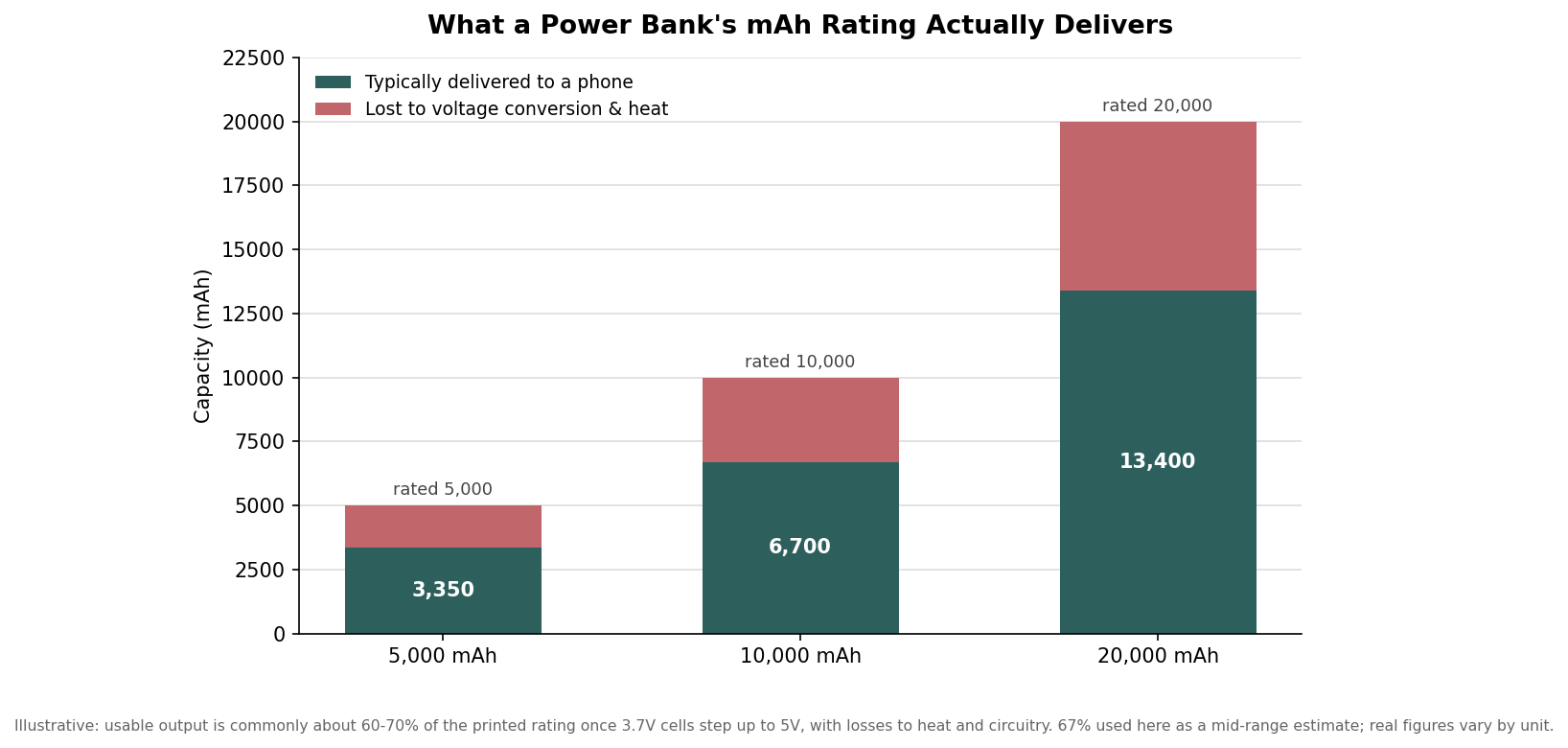
    Stacked bar chart showing the share of a power bank's rated mAh delivered to a phone versus lost to conversion
    A power bank typically delivers only about two-thirds of its printed mAh rating to a device.

    This matters for how you describe the product and which size you choose. If your goal is “one full phone charge on the go,” a 5,000 mAh unit that delivers roughly 3,300 usable mAh covers most phones once, and a 10,000 mAh unit gives a comfortable buffer. Promising “multiple charges” on a modest capacity invites disappointment. Treat the figures above as illustrative rather than a guarantee, because the exact conversion efficiency varies from one manufacturer and one cell chemistry to the next.

    Several real-world factors push the number lower still. A cheap or worn cable adds resistance and wastes power as heat. Cold weather temporarily reduces how much a lithium cell will give up. And the phone on the other end loses a little of its own during charging. The point is not to chase a precise figure but to set expectations honestly: a power bank is a top-up device sized to a use case, and a modest, accurately described unit beats an oversized one that recipients feel shortchanged by.

    Speccing yesterday’s ports

    Promotional power banks often sit in a warehouse for months and in a recipient’s drawer for longer, so the connectors you choose need to still make sense a year or two out. The recurring mistake is ordering a unit with a micro-USB input, or with only USB-A output and no USB-C. A modern recipient charges the bank itself over USB-C and expects to plug a USB-C phone cable straight in. A unit that forces them to dig out an old cable gets set aside. Specify USB-C input at a minimum, and USB-C output alongside USB-A if the budget allows. If the audience carries recent phones, USB-C Power Delivery output is worth asking about, because slow trickle charging is its own kind of letdown. It is also worth deciding early whether you want a built-in cable, a magnetic wireless pad for newer phones, or pass-through charging so the bank can power a device while it is itself being recharged. Each adds cost, but each also removes a small point of friction that determines whether the unit stays in a bag or migrates to a drawer.

    Buying more capacity than anyone will carry

    Bigger looks more generous on a spec sheet, but capacity is weight, and weight is what decides whether a power bank travels or stays home. A 20,000 mAh brick can push past 400 grams, roughly the weight of a full soda can, which is a lot to ask someone to carry for a logo. The scatter below shows how quickly grams pile up as capacity climbs.
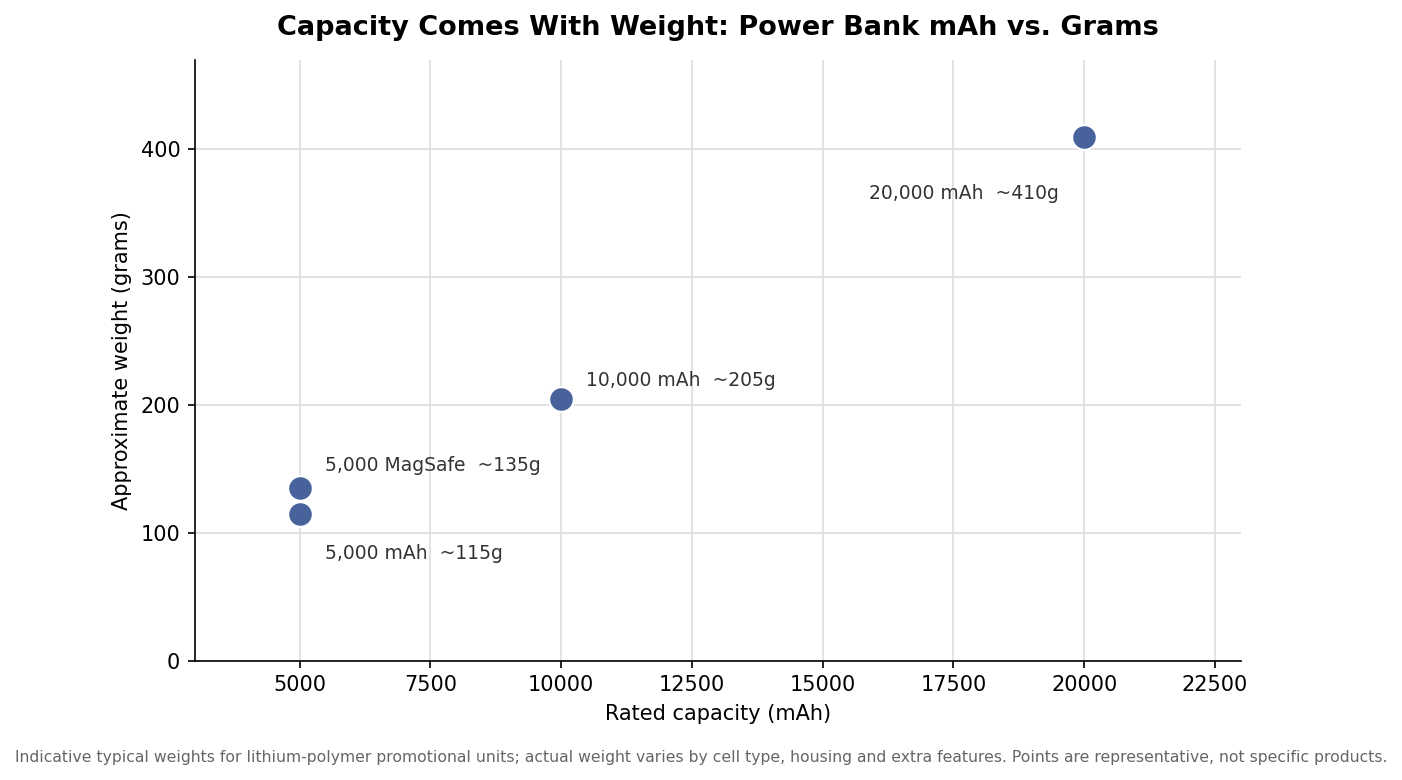
    Scatter plot of power bank rated capacity in mAh against approximate weight in grams
    Weight climbs steeply with capacity, which is what decides whether a unit gets carried or left at home.

    For most giveaways, a 5,000 or 10,000 mAh unit hits the sweet spot between useful and portable, and it costs less per unit, which lets your budget reach more people. Reserve the heavy 20,000 mAh units for audiences who genuinely want them, like field teams or travelers, and say so in how you position them. The weights above are indicative of typical lithium-polymer builds and will shift with housing and extra features.

    Forgetting these are lithium batteries you have to store, ship, and hand out

    A power bank is a regulated lithium battery, not a plain trinket, and that has three practical consequences people overlook. Shipping them in bulk falls under dangerous-goods rules, so lead times and freight are not the same as for a T-shirt. Handing them out at an event or mailing them to recipients can carry its own restrictions. And lithium cells self-discharge slowly while they sit, so a unit that spends six months in a box can arrive well below a full charge, which reads as a defect to someone opening it. Ask your supplier about certification documentation, plan the storage window, and, if units will sit for a long time, confirm they ship at a reasonable state of charge.

    Approving artwork without a pre-production sample

    The last mistake is skipping the physical proof. A logo that looks crisp on a flat mockup can land differently on a curved housing, a soft-touch coating, or a small print window, and color on a screen is not color on an anodized shell. On a run of several thousand units, a pre-production sample is cheap insurance against discovering a placement or color problem after everything is printed. Build the few extra days for a sample into the timeline rather than treating it as optional, and check the sample for fit and function too, not just the logo, because the charging behavior and the feel in the hand are part of what your brand is putting its name on.
  • How to Spec a Magnetic Wireless Power Bank for Your Brand

    How to Spec a Magnetic Wireless Power Bank for Your Brand

    Magnetic wireless power banks — the kind that snap onto the back of an iPhone and charge without a cable — have become one of the most requested promotional electronics of the past two years. They photograph well, they solve a real problem at conferences and trade shows, and they carry a logo on a flat, uninterrupted surface. But “MagSafe-compatible” is a loose phrase, and two units that look identical in a catalog can differ by nearly half in charging speed and holding strength. This walkthrough covers the specifications that actually matter when you place a custom order, so the purchase order you write gets you the product you pictured.

    What “MagSafe-compatible” actually promises

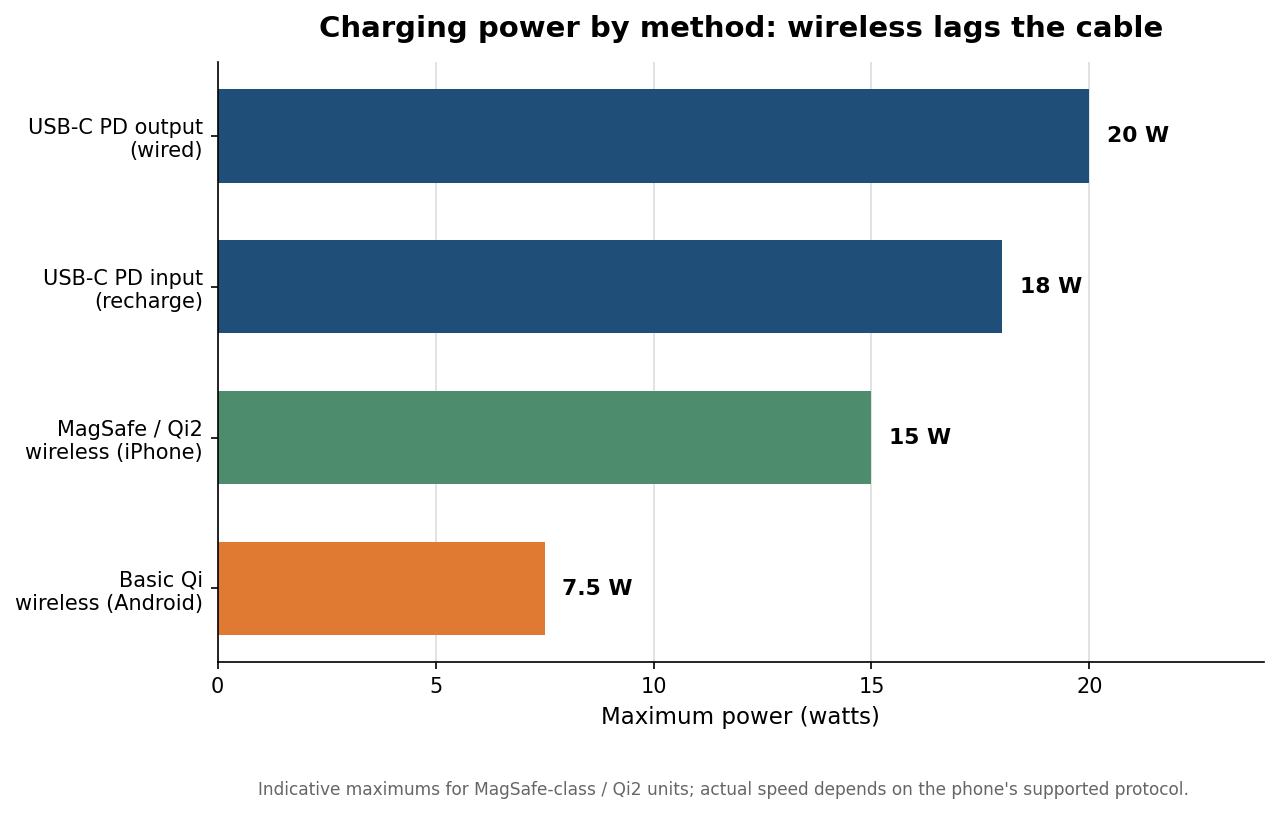
    MagSafe is Apple’s magnetic charging standard for the iPhone 12 and later. A true MagSafe-class accessory aligns to the phone with a ring of magnets and charges at up to 15 watts. The open-standard equivalent, Qi2, uses the same magnetic profile and also tops out at 15 watts, which is why most reputable factories now build to Qi2 and market it as MagSafe-compatible. The catch is on the Android side: phones without the magnetic ring fall back to basic Qi wireless, which is capped around 7.5 watts and offers no alignment help. If your audience is mixed-platform, set expectations accordingly — the magnetic snap and the faster speed are an iPhone benefit, while Android users get a slower, unaligned charge or reach for the cable.

    One more distinction is worth writing into the spec. Genuine magnetic alignment uses a concentric ring of magnets, not a handful of magnets around the perimeter. Perimeter-only designs let the phone slide sideways, which breaks the charging-coil alignment and quietly drops the wattage partway through a charge. Ask the factory to confirm a concentric ring array rather than assuming the marketing photo tells the truth.

    Horizontal bar chart comparing maximum charging power in watts: wired USB-C PD output 20W, PD input 18W, MagSafe/Qi2 wireless 15W, basic Qi wireless 7.5W
    Wireless charging tops out below the wired cable, and Android’s basic Qi is slower still.

    The three numbers that decide performance

    Three figures separate a good magnetic power bank from a disappointing one. The first is wireless output. Aim for a genuine 15W rating; units that sustain at least 12W keep an iPhone 14 or 15 charging at a useful pace, while anything advertised at 10W or below is really a basic-Qi part wearing a magnet. The second is magnet strength, measured in grams-force. A holding force around 450 gf keeps the pack attached while the phone rides in a pocket or gets handled; below roughly 350 gf, the unit tends to detach during normal movement, which is exactly when a wireless charger is least useful. The third is capacity, and here honesty matters: a 5,000mAh pack is the popular slim choice, but wireless transfer is meaningfully less efficient than a cable, so the real energy delivered to the phone runs lower than the printed number implies. Treat a wireless capacity claim as a ceiling rather than a guarantee, and if recipients need a full top-up on the go, step up to 10,000mAh or make sure the unit also has a wired path.

    On the wired side, specify a USB-C Power Delivery port. A 20W PD output charges a recent iPhone to roughly 50% in about half an hour, and a PD input of 18W or more keeps the pack’s own recharge time reasonable — slow 5V/2A inputs can take five hours or more to refill a 10,000mAh unit, which is a poor experience for anyone who relies on it daily.

    Battery, certifications, and whether it can fly

    Slim magnetic packs almost always use lithium-polymer pouch cells rather than cylindrical lithium-ion, because the flat format fits a phone-sized footprint and runs cooler. Expect roughly 300 to 500 full charge cycles before capacity settles toward 80% of the original rating, which is reasonable for a giveaway meant to last a year or two of light use. Before you sign off, request three documents by name: the FCC ID, a CE Declaration of Conformity that cites an actual notified-body number, and the UN38.3 transport test report. A “CE” mark with no notified body behind it is a warning sign, and the UN38.3 report is what keeps your shipment legal to move by air and sea.

    The airline question comes up constantly, so answer it in your recipient-facing copy. Lithium batteries are rated in watt-hours, and the carry-on limit without special airline approval is 100Wh. A 5,000mAh cell at 3.7 volts works out to about 18.5Wh, and a 10,000mAh cell to about 37Wh — both comfortably under the limit, and both must travel in carry-on baggage rather than checked luggage. For an event giveaway that people will pack for a flight home, that is a genuine selling point, and it costs nothing to state on the insert card.

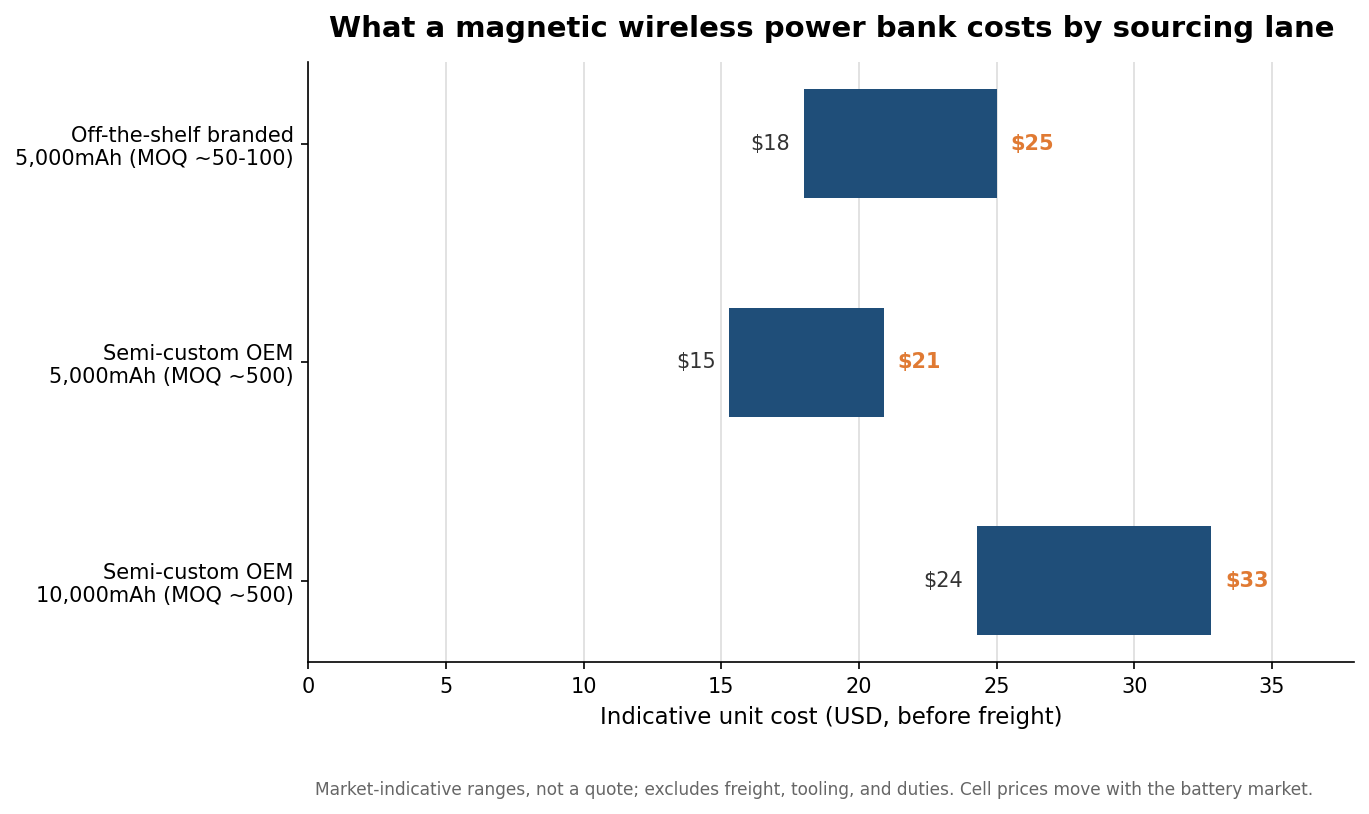
    Range chart of indicative per-unit cost in USD by sourcing lane for magnetic wireless power banks, from off-the-shelf branded to semi-custom OEM at two capacities
    Indicative unit-cost bands by sourcing lane, before freight and tooling.

    Sourcing paths, MOQs, and indicative pricing

    How you buy changes the price and the timeline more than any single spec. The fastest route is an off-the-shelf branded unit, where a factory prints your logo on an existing model. Minimums can run as low as 50 to 100 pieces and delivery lands in roughly two to four weeks. Indicative unit cost for a solid 5,000mAh magnetic pack in this lane sits in the high-teens to mid-twenties per piece before freight — and offers under about $12 deserve suspicion, since that price usually signals skipped safety verification or recycled cells. Stepping up to a semi-custom order, where you change the housing color or packaging, typically starts near a 500-piece minimum, adds a tooling charge, and pushes lead time to eight to twelve weeks. Full custom design from scratch is a several-thousand-unit, multi-month commitment that rarely makes sense for a promotional run. The numbers here are market-indicative rather than a quote; battery costs move with the commodity market, so confirm live pricing before you lock a budget.

    Specifying the imprint without hurting the unit

    The magnetic face is a clean canvas, but a few placement rules protect both the look and the hardware. Keep the logo away from any venting slots, because ink laid over a vent peels early and can trap heat. On a matte housing, UV printing holds fine color and photographs well, while laser engraving leaves a permanent mark that never wears — a worthwhile trade when longevity matters more than color. Avoid ultra-thin housings under about 4mm unless slimness is the entire point, since the thinnest packs sacrifice cell longevity and shed heat poorly. Finally, write an inspection clause into the order. The most common real-world complaints are units that run warm after twenty minutes and logos that shift on a small share of pieces, and both are catchable at a pre-shipment inspection when you reserve the right to one.

  • Can Your Custom Power Bank Fly? The 2026 Airline Rules, Explained

    Can Your Custom Power Bank Fly? The 2026 Airline Rules, Explained

    A branded power bank is one of the most genuinely useful gifts a company can hand out, which is exactly why it so often travels. Recipients throw it in a carry-on for a conference, a sales trip, or a holiday, and that is the moment airline battery rules come into play. Those rules tightened noticeably through 2025, and a gift that cannot clear security or that a flight attendant makes someone stow away is a poor advertisement. The good news is that the regulations are clear and that almost every promotional-sized power bank is well within them, provided you understand the one number that governs everything.

    Watt-hours, not milliamp-hours, are what the rules measure

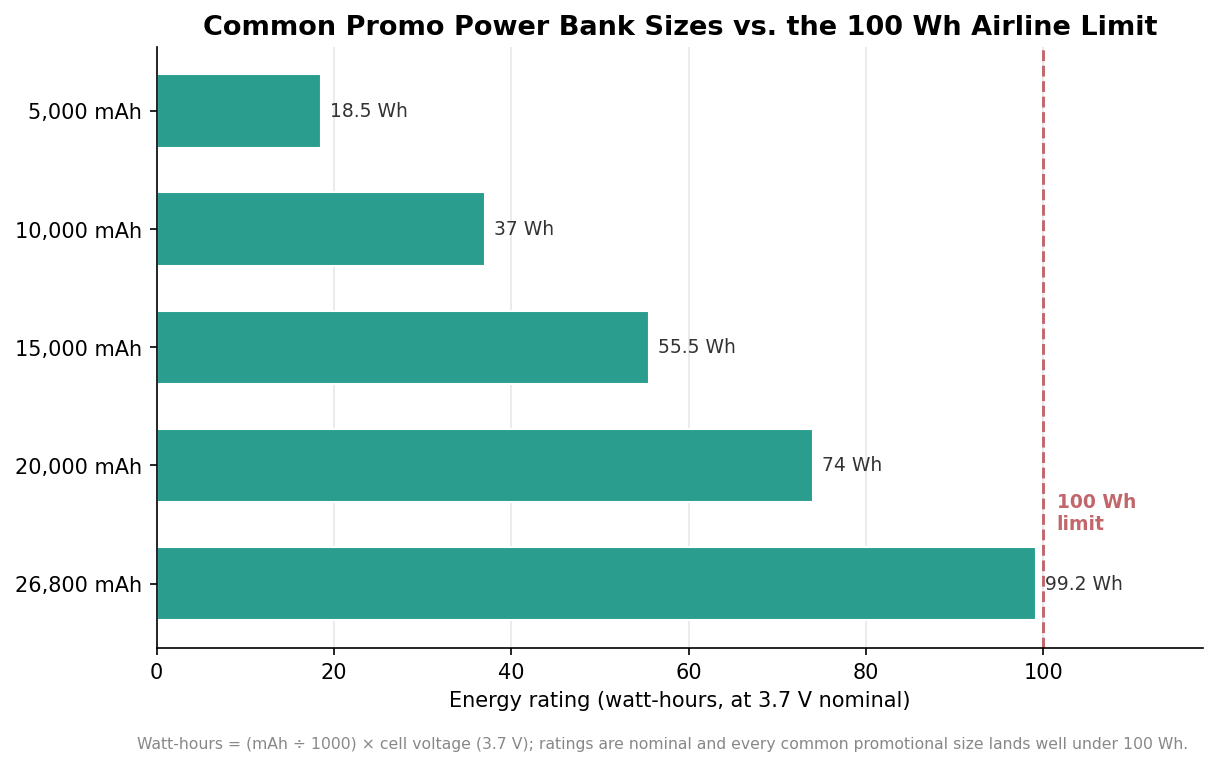
    Airlines and aviation regulators do not limit power banks by the milliamp-hour figure printed on the front. They limit them by energy, measured in watt-hours, because watt-hours reflect how much energy could be released in a fault. The conversion is simple: take the capacity in milliamp-hours, divide by 1,000 to get amp-hours, and multiply by the cell voltage, which for the lithium cells inside almost every power bank is a nominal 3.7 volts. A 10,000 mAh bank is therefore about 37 watt-hours, and a 20,000 mAh bank about 74 watt-hours. The regulatory ceiling that matters most, 100 watt-hours, works out to roughly 27,000 mAh, which is larger than the vast majority of promotional units.

    Bar chart converting common power bank capacities from mAh to watt-hours against the 100 watt-hour airline limit
    Every common promotional capacity from 5,000 to 20,000 mAh sits well under the 100 Wh carry-on limit.

    The practical consequence is reassuring for anyone ordering swag. The popular gifting capacities, from a slim 5,000 mAh up to a substantial 20,000 mAh, all sit comfortably under the 100 watt-hour line, so they need no special permission and travel as ordinary carry-on items. It is only when a bank pushes toward 26,800 or 27,000 mAh that it approaches the threshold, and a few oversized units climb past it.

    The three capacity zones

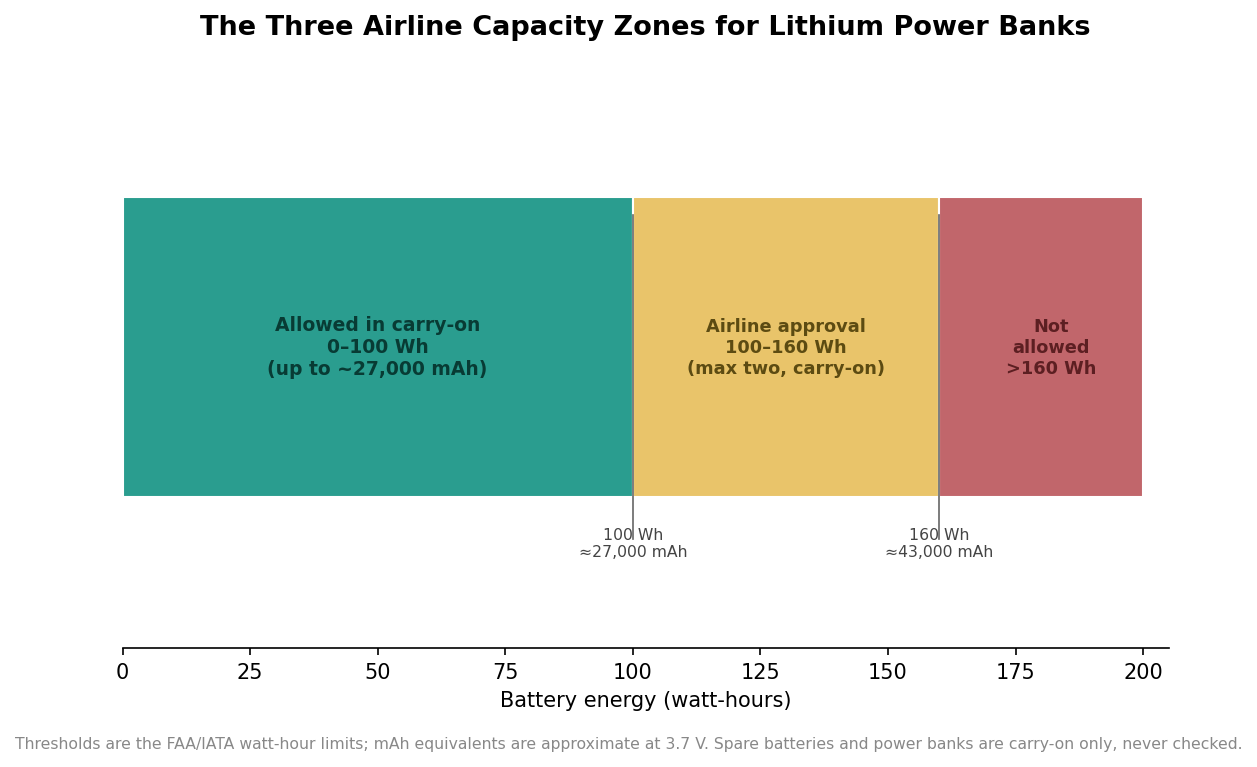
    The rules sort lithium power banks into three bands. Anything up to 100 watt-hours is allowed without approval and is the zone every sensible promotional product should live in. From 100 to 160 watt-hours, a bank is permitted only with the airline’s advance approval, and passengers may carry a maximum of two such batteries. Above 160 watt-hours, which corresponds to roughly 43,000 mAh, spare batteries and power banks are simply prohibited from passenger aircraft. One rule spans all three bands and catches people out constantly: power banks and spare batteries must travel in carry-on baggage and are forbidden in checked luggage, because a fire in the hold is far harder to fight than one in the cabin.

    Zone chart of the three airline power bank tiers: allowed under 100 Wh, approval 100-160 Wh, banned over 160 Wh
    The three regulatory bands by watt-hours, with approximate mAh equivalents at 3.7 volts.

    Carry-on only, and the short-circuit rule

    The carry-on requirement is worth restating because it is the rule travelers break most often by habit. A power bank tucked into a checked suitcase is not a minor infraction; spare lithium batteries and power banks are forbidden in the hold outright, because cabin crew can respond to a fire they can see and reach. Alongside that, regulators require spare batteries to be protected from damage and short circuit, which in practice means keeping a power bank away from keys, coins, and loose metal that could bridge its ports. For a promotional unit this is a small design point with real value: a recessed or capped USB port, a hard shell rather than a bare cell, and a housing that survives being knocked around a bag all make the gift both safer and more likely to keep working. It is a reminder that build quality and compliance are the same conversation, not two separate ones.

    The 2025 change: keep it in reach and don’t charge it in flight

    The newer wrinkle is not about capacity at all but about how a power bank is stored and used during the flight. After a series of in-cabin battery fires, including incidents on Air China and Air Busan flights and a run of lithium battery events across US aviation in 2025, a large group of carriers changed their in-flight rules. The Lufthansa group of airlines, along with Southwest, Qantas, Emirates, Singapore Airlines, Cathay Pacific, Korean Air, Thai Airways and others, now variously prohibit using or charging a power bank in flight and require that it be kept within reach, under the seat in front or in the seat pocket, rather than in an overhead bin where a fault could smolder unseen. The exact wording differs by airline and continues to evolve, so the honest guidance to pass along with a gift is to keep the power bank accessible, avoid charging from it during the flight where prohibited, and check the specific airline’s current policy before flying.

    What to specify for a power bank that travels well

    For a corporate gift, the design brief writes itself once the rules are clear. Choose a capacity in the everyday range, roughly 5,000 to 20,000 mAh, which keeps the unit far below the 100 watt-hour limit and out of the approval bracket entirely; a 10,000 mAh unit around 37 watt-hours is a common sweet spot that charges most phones once or twice while staying pocketable. Insist that the supplier’s cells carry the standard lithium transport testing, commonly referenced as UN38.3, and that the finished unit shows its watt-hour or capacity rating clearly on the housing, because a bank with no legible rating is the one most likely to be questioned at a checkpoint. Steer clear of very high-capacity 30,000 mAh-plus units for broad giveaways, since those are the ones that flirt with or cross the approval line.

    None of this should discourage a power bank as a gift; it argues for choosing the right one. A well-specified unit in the common capacity range is not just compliant, it is the version people can actually use everywhere they go, which is the whole point of putting a logo on it. Match the capacity to the rules and the printing to the brand, and the gift keeps working long after the event, in exactly the airports and airline seats where a dead phone is most frustrating.

  • Power Bank Safety Certifications and Battery Rules Every Buyer Should Check

    Power Bank Safety Certifications and Battery Rules Every Buyer Should Check

    A branded power bank is a battery first and a marketing item second, and batteries are regulated the world over. That single fact changes how you should buy one. A T-shirt that fails to impress is a waste of money; a power bank that lacks the right paperwork can be blocked from air freight, held at customs, or taken from your recipient at an airport gate. None of that shows up in a product photo, so the compliance questions are the ones worth asking before you place the order, not after the pallet is sitting on a dock.

    The certifications that actually matter

    Several marks get thrown around, and they are not interchangeable. UN 38.3 is the one you cannot skip: it is a United Nations transport-safety test that every lithium battery must pass to move legally by air, sea, or road. It subjects cells to altitude simulation, thermal cycling, vibration, shock, external short circuit, impact, overcharge, and forced discharge. Without a UN 38.3 test report, a freight forwarder should refuse the shipment, so ask for it by name.

    UL 2056 is the North American safety standard written specifically for power banks, covering overcharge and over-discharge protection, short-circuit response, overload handling, drop resistance, and temperature behavior. Worth knowing: it functions as a testing standard, so a compliant unit will not always carry a visible UL mark, and you may need to request the test report rather than look for a logo. Beyond those two, CE covers sale into the European Union, FCC covers electromagnetic interference for the United States, and RoHS restricts hazardous substances such as lead and cadmium. Sell into other markets and the list grows: PSE for Japan, KC for South Korea, CCC for mainland China. You do not need every mark for every order, but you do need the ones that match where the product will ship and where it will be used.

    Watt-hours, not milliamp-hours, are what airlines check

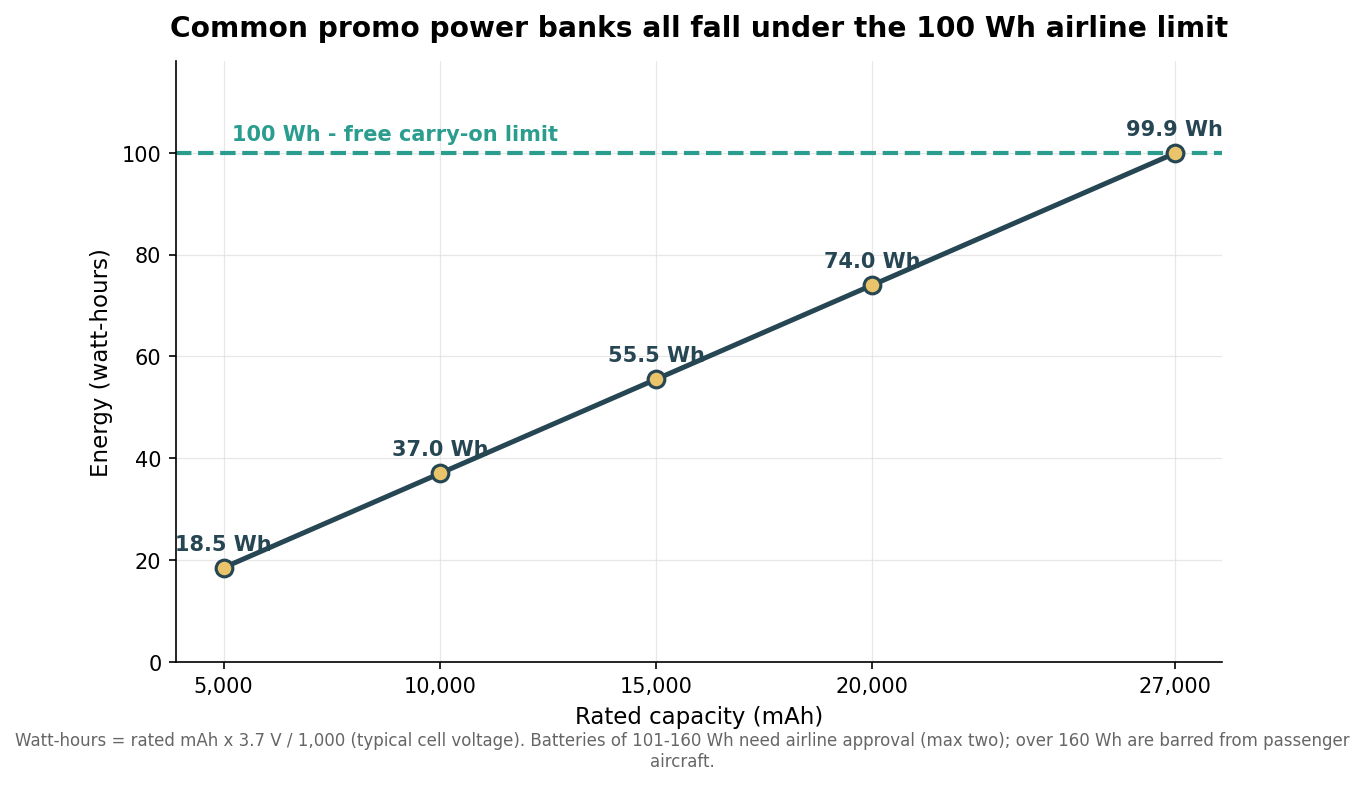
    Buyers fixate on milliamp-hours because that is the number printed on the case, but aviation rules are written in watt-hours. The conversion is straightforward: multiply the rated capacity in milliamp-hours by the cell voltage, typically 3.7 volts, then divide by 1,000. A 10,000 mAh bank works out to about 37 Wh, a 20,000 mAh bank to about 74 Wh, and even a large 27,000 mAh unit lands near 99.9 Wh, just under the line.

    Line chart converting power bank capacity in mAh to watt-hours against the 100 Wh airline carry-on limit
    Nearly all promotional power banks fall well under the 100 Wh threshold airlines allow without approval.

    That line matters because current FAA guidance lets passengers freely carry batteries up to 100 Wh in carry-on baggage. From 101 to 160 Wh, a traveler needs the airline’s approval and may bring no more than two spares. Above 160 Wh, the battery is forbidden on passenger aircraft entirely. The practical takeaway for promotional buyers is reassuring: virtually every giveaway-sized power bank, from 5,000 to 20,000 mAh, sits comfortably under 100 Wh, so your recipients can travel with them without special permission. It is only the oversized, high-capacity units that stray into approval territory.

    The 2026 in-flight rules your recipients will meet

    Handling rules tightened noticeably in 2026, and it is worth knowing so you can set expectations. Under the IATA Dangerous Goods Regulations that took effect on January 1, 2026, charging a power bank from an in-seat USB port or outlet is now prohibited in flight, and power banks may not be used to charge devices during taxi, takeoff, or landing. Individual carriers went further: United Airlines, effective March 1, 2026, barred power banks from overhead bins, requiring that they stay on the passenger, in a seat pocket, or in an under-seat bag where crew can see them, and a number of Emirates, Korean, Japanese, Australian, and European carriers adopted comparable mid-flight restrictions. Across all of it, one rule has never changed and remains the most important: lithium power banks belong in carry-on baggage and must never be packed in checked luggage, because a fire in the hold is far more dangerous than one in the cabin.

    Rated capacity is not what comes out of the port

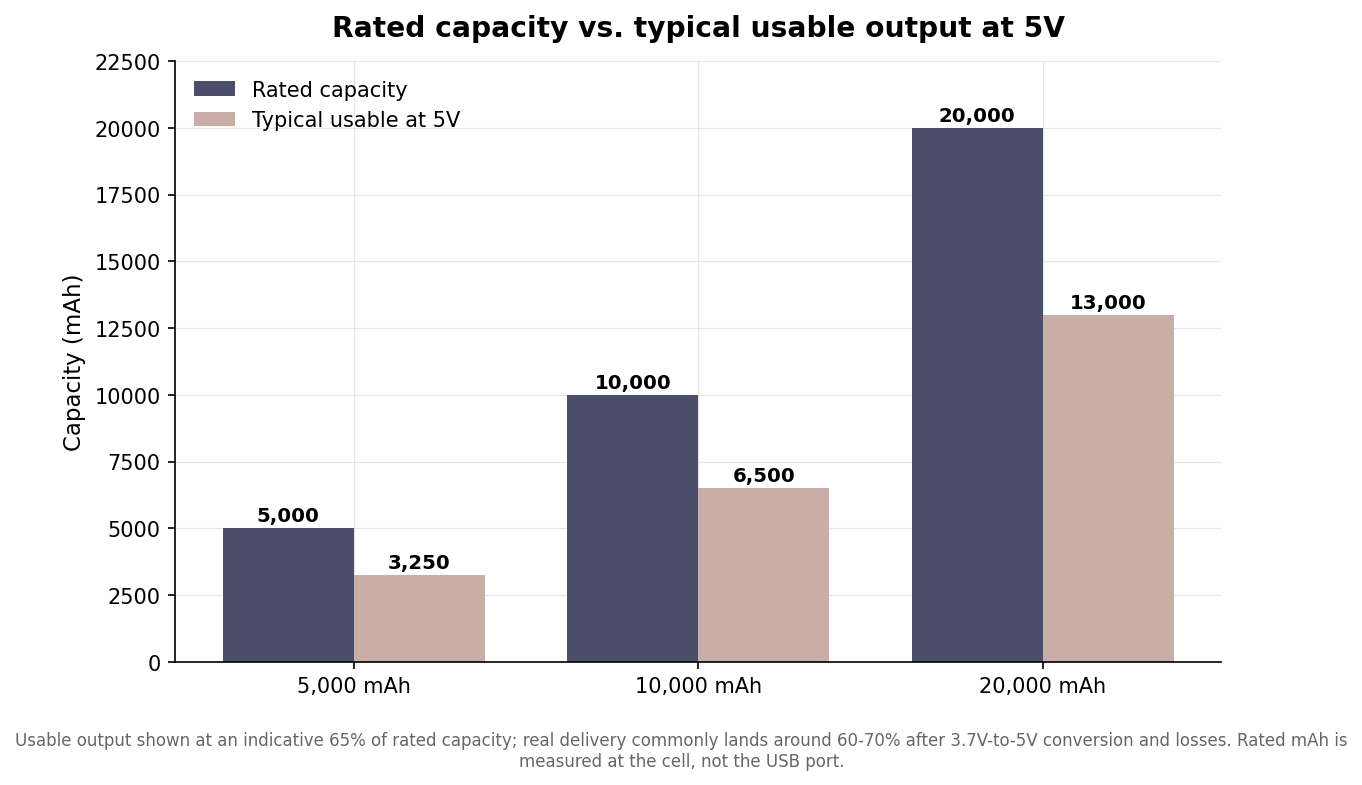
    There is an honest gap between the capacity printed on a power bank and the charge it actually delivers, and it is not a defect. The cells inside store energy at roughly 3.7 volts, while the USB output steps up to 5 volts, and that conversion plus normal heat and circuit losses means usable output typically lands somewhere around 60 to 70 percent of the rated figure. A 10,000 mAh bank, in other words, realistically delivers something closer to 6,000 to 7,000 mAh at the port, which is usually a bit under two full charges for a modern phone rather than the two-and-a-half the raw number implies.

    Grouped bar chart comparing rated power bank capacity to typical usable output at 5 volts
    Usable output at the USB port typically runs 60 to 70 percent of the rated capacity.

    Those percentages are indicative rather than exact, and efficiency varies with the specific unit, the device being charged, and temperature. The reason to understand it is to avoid two traps: overpromising in your own marketing copy, and falling for a supplier quoting an impossibly high capacity in a suspiciously small, light housing. If the rated milliamp-hours seem too generous for the size and weight, they usually are, and inflated capacity claims are one of the most common problems in cheap battery products.

    How to verify before you commit

    The single best habit is to ask for documentation in writing. Request the UN 38.3 test summary and the relevant safety and market certifications for your destination, and confirm the actual cell capacity rather than accepting only a headline number. Order a pre-production sample and, if you can, weigh it and test how many phone charges it genuinely provides, since a real unit tells you more than any spec sheet. Confirm with your freight forwarder how the batteries will ship, because lithium cells travel under specific packing and labeling rules that add cost and time you want to know about early. A power bank is one of the most useful items you can put a logo on, carried and reached for daily, but that value only holds if the product underneath is safe, legal to move, and honest about what it stores. The paperwork is the part that protects all of it.

  • Bulk Power Banks: A Buyer’s Walkthrough of MOQs, Price Breaks, and Lithium Shipping

    Bulk Power Banks: A Buyer’s Walkthrough of MOQs, Price Breaks, and Lithium Shipping

    Ordering power banks in bulk looks like a commodity purchase right up until the first quote lands and every line reads differently: one supplier wants 100 units, another 500, and the per-piece price swings by a factor of five depending on capacity and imprint. The chargers themselves are a mature product, so the real work of a bulk order is specifying the right combination of capacity, decoration, and shipping method before you commit. Get those three right and the order is boring in the best way. Get them wrong and you learn about lithium-battery paperwork the hard way, usually with a container sitting at a port.

    Start with capacity, because it sets your minimum order

    Capacity is the first decision because it quietly determines your minimum order quantity and your floor price. Suppliers group promotional power banks into tiers, and each tier carries its own MOQ. A basic 5,000mAh unit typically starts around 50 to 100 pieces. A 10,000mAh model with USB-C Power Delivery generally runs a 100 to 300 piece minimum. Qi wireless models that charge a phone on contact tend to start at 200 to 500 units, and MagSafe-compatible magnetic banks sit at the same 300 to 500 range. A fully custom, tooled-from-scratch design is a different animal and usually needs 1,000 units or more to justify the mold.

    For most branded giveaways, a 10,000mAh USB-C bank is the sensible middle. It holds roughly two full phone charges, it is the capacity buyers now expect, and it stays comfortably inside the shipping thresholds discussed below. A 10,000mAh cell at a nominal 3.7 volts is about 37 watt-hours; even a 20,000mAh unit lands near 74 watt-hours, which matters more than it sounds once the freight forwarder gets involved.

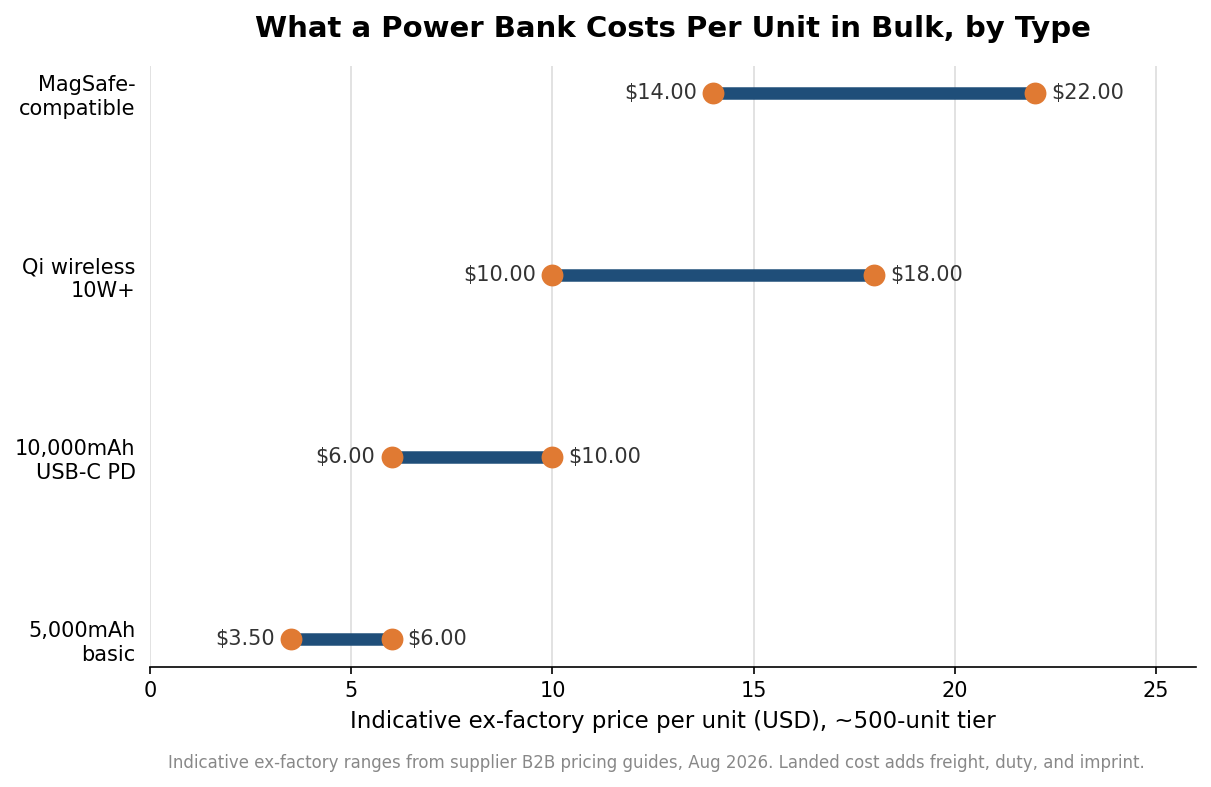
    Range chart of indicative ex-factory per-unit power bank prices by type at the 500-unit tier
    Per-unit factory prices by capacity and type; landed cost adds freight, duty, and imprint.

    What quantity actually does to the per-unit price

    Bulk pricing is real, but it is not linear, and it flattens faster than buyers expect. Indicative ex-factory pricing at a 500-unit tier runs roughly $3.50 to $6.00 for a 5,000mAh basic bank, $6.00 to $10.00 for a 10,000mAh USB-C model, $10.00 to $18.00 for a Qi wireless unit, and $14.00 to $22.00 for a MagSafe-compatible bank. Those are factory prices for the bare unit; your landed cost adds ocean freight, import duty, and the imprint, so treat them as a floor rather than a delivered figure.

    The steepest savings come from clearing the first real MOQ, not from chasing enormous volumes. Moving from a no-minimum sample run to a 500-unit order is where the per-piece cost drops the most; going from 500 to 1,000 shaves a good deal less. If a vendor quotes a single flat price regardless of quantity, ask them to break it out by tier, because a genuine bulk supplier prices in bands. Where a figure like this is a range rather than a firm number, it is because capacity, cell quality, and certification all move the price within it.

    Imprint method changes durability, cost, and the minimum

    How your logo goes on the case is not a cosmetic afterthought; it interacts with both minimum order and unit cost. Laser engraving is the most durable option because it removes or darkens the surface material rather than sitting on top of it, so it will not scuff off in a bag over months of use. It carries a higher decoration cost and generally needs around 100 units. UV printing reproduces full color and fine gradients, works from about 50 units, and sits in the middle on both price and longevity. Silk screen printing is the cheapest per piece for a simple one or two color mark, but it tends to want a higher run of around 500 units to be worthwhile.

    Match the method to the lifespan of the campaign. A conference handout that needs to look sharp for a weekend does not need laser engraving; a device you want employees carrying for two years does. If your brand color has to be exact, UV printing holds a Pantone target more reliably than engraving, which reveals the case material’s own color.

    The lithium rules that quietly decide your lead time

    Every power bank is a lithium-ion battery, which means it ships as regulated cargo, and two documents govern whether it moves at all. The first is a UN38.3 test report, the battery’s transport passport, confirming it passed a battery of tests including altitude simulation, thermal shock, and vibration. It is mandatory for both air and sea freight. The second is a current Material Safety Data Sheet; freight forwarders and customs brokers will not book space without it, and an out-of-date version is a common reason shipments get rejected.

    Watt-hours set the difficulty. Units under 100 watt-hours, which covers essentially all promotional power banks, face lighter handling and can qualify for reduced provisions, while anything over 100 watt-hours becomes fully regulated Class 9 dangerous goods with stricter packaging and higher freight cost. There is also a classification split worth knowing: a bank shipped on its own is UN3480 and draws the most airline scrutiny, while one packed with or inside equipment is UN3481 and moves more easily. Sea freight in a full container load is the standard path for bulk stock; air is reserved for urgent samples through a courier’s dangerous-goods service and costs far more.

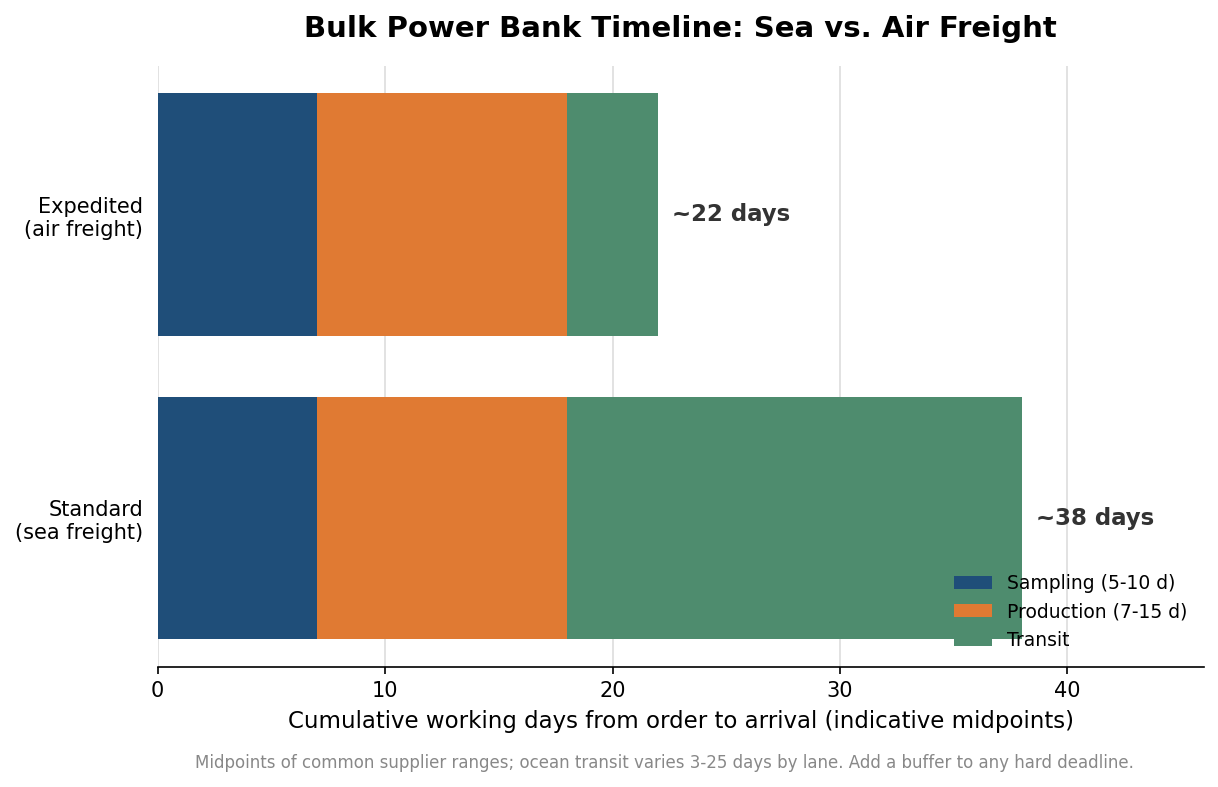
    Stacked bar comparing bulk power bank lead times for sea versus air freight across sampling, production, and transit
    A typical order-to-arrival timeline for sea versus air freight, using midpoint durations.

    Building a timeline you can actually promise

    Put the pieces together and a realistic schedule emerges. Sampling runs about 5 to 10 days, mass production another 7 to 15 depending on capacity, and ocean transit anywhere from 3 to 25 days by lane. That is why suppliers advise starting at least eight weeks ahead of any hard date such as a trade show, and the buffer exists precisely because the lithium paperwork and customs clearance are the least predictable stretch. If your event is closer than that, expedited air freight can compress the transit leg dramatically, but it raises both the freight bill and the compliance overhead, so it is a rescue plan rather than a default. Order the samples early, confirm the UN38.3 report and MSDS are in hand before production finishes, and the rest of a bulk power bank order tends to run on rails.

  • A Tech Company’s Guide to Power Bank Swag Margins — Customized Power Banks

    Call or Text us: (929) 605-4397

    Home › Blog › A Tech Company's Guide to Power Bank Swag Margins

    Margins

    A Tech Company's Guide to Power Bank Swag Margins

    06/30/2026

    Marketing and people-ops teams at tech and SaaS companies often price a branded power bank as a pure cost center — a line item in the swag budget with no return attached. That framing misses how the item actually performs compared to the rest of a typical swag closet: highest daily-use rate, longest visible lifespan, and a real cost-per-impression that beats almost everything else you could buy.

    Here’s how to think about the economics before your next order.

    Cost per impression, not just cost per unit

    A branded power bank gets pulled out of a bag every time someone’s phone dies — often multiple times a week for a heavy phone user — and each pull is a fresh look at your logo, frequently in a shared space like an office, coffee shop, or classroom. Compare that to a t-shirt worn a handful of times a year, or a pen that gets lost within a month, and the cost-per-impression math favors the power bank even at a higher unit price.

    Typical volume pricing

    Order sizeTypical per-unit range*
    100$18–$22
    500$13–$18
    2,000$10–$14
    5,000+$8–$11

    *Estimates only, illustrative of typical volume pricing — request a quote for your exact specs and style.

    Where the budget conversation goes wrong

    The most common mistake is comparing a power bank’s unit cost directly against a cheap giveaway like a sticker or lanyard, then concluding it’s “too expensive” for a mass giveaway. The better comparison is against your cost of customer acquisition or your recruiting cost-per-hire — a $12 power bank that a candidate keeps for two years and shows to colleagues is cheap relative to either number.

    Setting your program budget

    A simple rule of thumb for tech and SaaS teams: reserve your higher-capacity or wireless-charging models for high-value touchpoints (investor meetings, executive onboarding, key accounts) where the per-unit cost is easily justified, and use the 5000mAh Slim model for high-volume touchpoints (conferences, general onboarding, referral gifts) where the lower price point lets the budget stretch further.

    Key takeawayJudge power bank swag on cost-per-impression against acquisition or hiring costs, not against cheap giveaways — and split your budget between a high-volume style and a premium style by touchpoint.

    Ready to plan your program’s economics? Get a custom quote — free mockups in 24–48 hours. Learn more about how we work, or browse more guides.

    More posts

  • How to Order Custom Power Banks: A Step-by-Step Checklist — Customized Power Banks

    Call or Text us: (929) 605-4397

    Home › Blog › How to Order Custom Power Banks: A Step-by-Step Checklist

    Ordering

    How to Order Custom Power Banks: A Step-by-Step Checklist

    06/01/2026

    Ordering a custom power bank for the first time involves a handful of decisions that are easy to make quickly once you know what to have ready. This checklist walks through the process in the order we actually need the information, from first quote request to delivery.

    1. Gather your artwork

    Have your logo ready as a vector file (AI, EPS, SVG, or PDF) if possible. If you only have a PNG or a photo of your logo, that’s fine too — our designers will recreate it print-ready at no charge.

    2. Decide on quantity

    An exact number isn’t necessary at the quote stage — an estimate is enough to get accurate bulk pricing. Our minimum is 100 units, and pricing improves at higher volumes, so it’s worth telling us if you’re flexible on quantity.

    3. Pick a style and capacity

    Choose from our five styles based on your use case — the 5000mAh Slim for high-volume giveaways, the 10000mAh for a more substantial gift, Wireless Charging for VIP tiers, the Cable Gift Set for a complete unboxing, or Rugged Outdoor for field and event use. Not sure? Tell us your audience and we’ll recommend one.

    4. Choose a color and decoration method

    Pick from Matte black, White, Navy, or a custom Pantone-matched print, and decide between UV printing (full color) or laser engraving (permanent, single tone).

    5. Submit your quote request

    Send your artwork, estimated quantity, style, and color preference through our quote form. We reply within one business day with a photo-real mockup and bulk pricing.

    6. Review and revise your mockup

    Review the mockup for logo placement, color accuracy, and sizing. Revisions are free and unlimited — take as many rounds as you need until it’s right.

    7. Approve and pay

    Once you sign off on the final mockup, we lock the design and begin production the same day.

    8. Production & shipping

    Standard production takes about 3 weeks from approval. Rush timelines are available if you’re working against a fixed event date — ask when you submit your quote.

    StepTypical timing
    Quote & mockup1 business day
    RevisionsAs needed, free
    Approval to production startSame day
    Production & shipping~3 weeks
    Key takeawayHave your logo and a rough quantity ready, and the path from quote to delivery is predictable: one business day to a mockup, unlimited free revisions, and about 3 weeks to ship after approval.

    Ready to start? Get a custom quote — free mockups in 24–48 hours. Learn more about how we work, or browse more guides.

    More posts

  • UV Print vs. Laser Engraving: Which Logo Lasts Longer on a Power Bank — Customized Power Banks

    Call or Text us: (929) 605-4397

    Home › Blog › UV Print vs. Laser Engraving: Which Logo Lasts Longer on a Power Bank

    Durability

    UV Print vs. Laser Engraving: Which Logo Lasts Longer on a Power Bank

    05/10/2026

    A power bank spends its life getting tossed into bags, dropped on desks, and jostled against keys and chargers — more daily wear than most branded merchandise sees. Choosing a decoration method that can survive that environment matters more here than it does on, say, a tote bag.

    Both of our methods are built to last, but they hold up differently, and the right pick depends on your logo and how the item will be carried.

    How each method is applied

    UV printing cures full-color ink directly onto the ABS shell using ultraviolet light, bonding it into the surface rather than sitting on top like a sticker. Laser engraving uses a focused laser to etch the design into the shell material itself, removing a thin layer of the surface to create a permanent, tactile mark.

    Durability side by side

    FactorUV PrintLaser Engraving
    Color capabilityFull color, gradientsSingle tone (shell color shows through)
    Resistance to scuffingVery good — bonded, not surface-levelExcellent — etched into the material
    Resistance to fadingGood with standard usePermanent, will not fade
    FeelSmooth, flush with surfaceSlightly textured, tactile
    Best forMulti-color logos, bold brandingSingle-color marks, premium feel

    Which one actually lasts longer

    In practical terms, both methods are built to outlast the useful life of the power bank itself under normal daily handling. Laser engraving has a slight edge in raw permanence since there’s no ink layer to wear at all — the mark is the material. UV print is not far behind for typical bag-and-desk use, and it’s the only option if your logo relies on multiple colors or a gradient, since engraving renders everything in a single tone.

    Choosing for your order

    If your logo is a single color or a simple wordmark, laser engraving gives you the most durable, premium-feeling result. If your logo depends on color — a gradient, a multi-color mark, or brand colors that need to read accurately — UV print is the only way to reproduce it faithfully, and it holds up extremely well to daily carry regardless.

    Key takeawayLaser engraving is the most permanent option for single-color logos; UV print is the only way to reproduce full-color branding, and both hold up to daily bag wear.

    Not sure which fits your logo? Get a custom quote — we’ll mock up both if helpful. Learn more about how we work, or browse more guides.

    More posts

  • Custom Power Banks for Universities & Student Orgs — Customized Power Banks

    Call or Text us: (929) 605-4397

    Home › Blog › Custom Power Banks for Universities & Student Orgs

    Universities

    Custom Power Banks for Universities & Student Orgs

    04/19/2026

    Of all the swag options a university department or student organization can hand out, a power bank solves a problem students actually have on a daily basis: a dead phone between classes, at a football game, or during a late library session. That practical value is why it consistently outperforms generic giveaways at orientation and campus events.

    Here’s how campus buyers typically plan and budget for a power bank program.

    Where power banks fit on a campus calendar

    Orientation week is the biggest single event most schools run, often needing 500–2,000 units for a single incoming class. Beyond orientation, student government, Greek life chapters, and club sports teams order smaller batches of 100–300 for tabling events, recruitment drives, and homecoming weekend.

    Budgeting on a student org timeline

    Most student orgs and university departments work with fixed annual budgets set months in advance, so our 3-week production window is easy to plan around as long as the order goes in ahead of the event date, not the week before. We recommend locking in artwork and quantity at least 5 weeks out to leave room for a mockup round and any budget approval delays on the school’s side.

    Campus use caseTypical quantityRecommended style
    Freshman orientation500–2,0005000mAh Slim Power Bank
    Student org tabling100–3005000mAh Slim Power Bank
    Fundraising / raffle prize50–15010000mAh Power Bank
    Athletics / homecoming300–1,000Rugged Outdoor Power Bank

    Getting the branding right

    Most campus orders use school colors and a Pantone-matched print of the university seal or mascot, since students respond to spirit-marked items far more than a plain department logo. We can also personalize a small batch with a graduation year or event name for senior class gifts or reunion giveaways.

    Choosing for your order

    If you’re ordering for a single big event, the 5000mAh Slim model keeps cost manageable at high volume. If the program is smaller and gift-like — a scholarship recognition or raffle prize — the 10000mAh model reads as a more considered gift for the budget.

    Key takeawayLock artwork and quantity at least 5 weeks before your event date, and match volume-heavy orientation orders to the 5000mAh Slim model.

    Planning a campus order? Get a custom quote — free mockups in 24–48 hours. Learn more about how we work, or browse more guides.

    More posts

  • 5,000mAh vs. 10,000mAh: Choosing the Right Custom Power Bank Capacity — Customized Power Banks

    Call or Text us: (929) 605-4397

    Home › Blog › 5,000mAh vs. 10,000mAh: Choosing the Right Custom Power Bank Capacity

    Buyer Guides

    5,000mAh vs. 10,000mAh: Choosing the Right Custom Power Bank Capacity

    03/29/2026

    Capacity is the first spec buyers ask about, and the least understood. A bigger number sounds better, but it isn’t automatically the right choice — it’s a trade-off between size, weight, cost, and how much charge your recipients realistically need.

    Here’s a straightforward way to think about it before you order.

    What the numbers actually mean

    A 5,000mAh cell delivers roughly one full charge to an average smartphone, accounting for normal conversion loss. A 10,000mAh cell roughly doubles that, delivering close to two full phone charges or one phone charge plus a tablet top-off. Neither number is exact — actual output depends on the recipient’s device battery size and charging efficiency.

    Size, weight, and daily carry

    The 5,000mAh cell lives in a genuinely pocket-thin shell that disappears into a bag pocket, which matters when the goal is a giveaway people actually carry around, not one they leave in a drawer. The 10,000mAh cell is noticeably larger and heavier, which reads as more substantial for a desk-based gift but is a real downside for a giveaway meant for daily portability.

    Factor5,000mAh10,000mAh
    Approx. charges delivered~1 full phone charge~2 full phone charges
    ProfilePocket-thinNoticeably thicker/heavier
    Best fitHigh-volume giveawaysClient & executive gifts
    Typical price positionLower end of rangeHigher end of range

    Matching capacity to your program

    For trade shows, orientation events, and any giveaway where volume matters more than a single standout gift, the 5,000mAh Slim model hits the budget and portability sweet spot. For client gifts, executive onboarding, or donor recognition — anything where the item is meant to sit on a desk and be noticed — the 10,000mAh model, often with its digital display, earns its higher price with a more substantial feel.

    Choosing for your order

    If you’re building one program with two audiences — say, a general trade-show giveaway plus a VIP gift tier — it’s common to order both: 5,000mAh for the general run, 10,000mAh for the smaller VIP batch, combined into a single quote for better overall pricing.

    Key takeawayChoose 5,000mAh for high-volume, portable giveaways and 10,000mAh for smaller, higher-value gifts where size and display matter more than pocket-thinness.

    Ready to compare capacities for your program? Get a custom quote — free mockups in 24–48 hours. Learn more about how we work, or browse more guides.

    More posts