A custom power bank looks like a simple giveaway: pick a capacity, print a logo, hand them out. The trouble is that most of the decisions that determine whether recipients actually like the thing get made at spec time, months before anyone plugs a phone into it. The mistakes below are the ones that tend to surface only after a few thousand units have shipped, when they are expensive to fix. None of them require deep electrical knowledge to avoid, just the right questions before you approve the order.
Reading the printed mAh as the charge it delivers
The single most common misunderstanding is treating the number on the label as the energy that reaches a phone. The rating describes the internal cells, measured at their native 3.7 volts. Your phone charges at 5 volts or higher, and stepping the voltage up loses energy to heat and circuitry along the way. In practice a unit delivers somewhere around 60 to 70 percent of its printed rating to a device, which is why a “10,000 mAh” bank rarely gives a 4,000 mAh phone two and a half full charges.
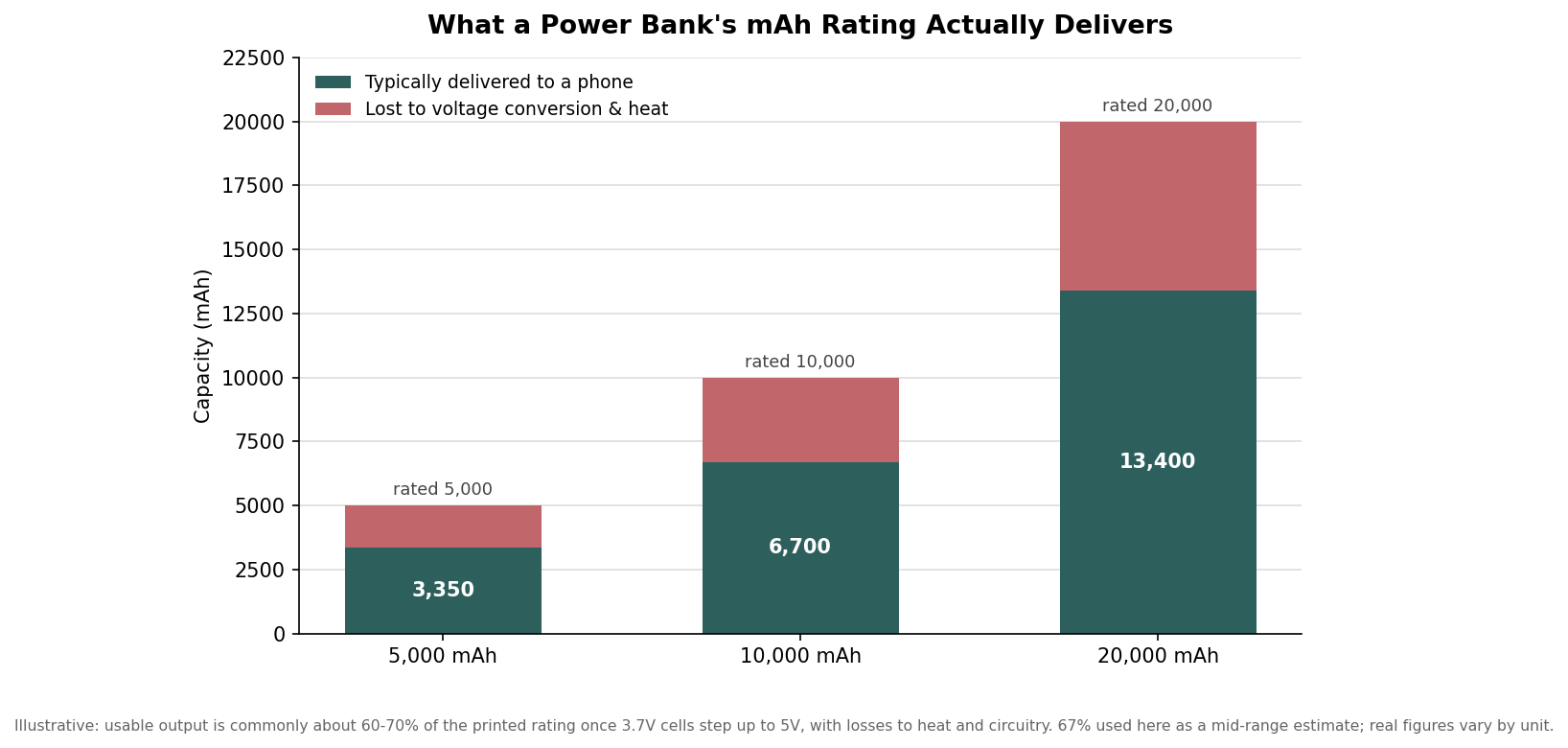
This matters for how you describe the product and which size you choose. If your goal is “one full phone charge on the go,” a 5,000 mAh unit that delivers roughly 3,300 usable mAh covers most phones once, and a 10,000 mAh unit gives a comfortable buffer. Promising “multiple charges” on a modest capacity invites disappointment. Treat the figures above as illustrative rather than a guarantee, because the exact conversion efficiency varies from one manufacturer and one cell chemistry to the next.
Several real-world factors push the number lower still. A cheap or worn cable adds resistance and wastes power as heat. Cold weather temporarily reduces how much a lithium cell will give up. And the phone on the other end loses a little of its own during charging. The point is not to chase a precise figure but to set expectations honestly: a power bank is a top-up device sized to a use case, and a modest, accurately described unit beats an oversized one that recipients feel shortchanged by.
Speccing yesterday’s ports
Promotional power banks often sit in a warehouse for months and in a recipient’s drawer for longer, so the connectors you choose need to still make sense a year or two out. The recurring mistake is ordering a unit with a micro-USB input, or with only USB-A output and no USB-C. A modern recipient charges the bank itself over USB-C and expects to plug a USB-C phone cable straight in. A unit that forces them to dig out an old cable gets set aside. Specify USB-C input at a minimum, and USB-C output alongside USB-A if the budget allows. If the audience carries recent phones, USB-C Power Delivery output is worth asking about, because slow trickle charging is its own kind of letdown. It is also worth deciding early whether you want a built-in cable, a magnetic wireless pad for newer phones, or pass-through charging so the bank can power a device while it is itself being recharged. Each adds cost, but each also removes a small point of friction that determines whether the unit stays in a bag or migrates to a drawer.
Buying more capacity than anyone will carry
Bigger looks more generous on a spec sheet, but capacity is weight, and weight is what decides whether a power bank travels or stays home. A 20,000 mAh brick can push past 400 grams, roughly the weight of a full soda can, which is a lot to ask someone to carry for a logo. The scatter below shows how quickly grams pile up as capacity climbs.
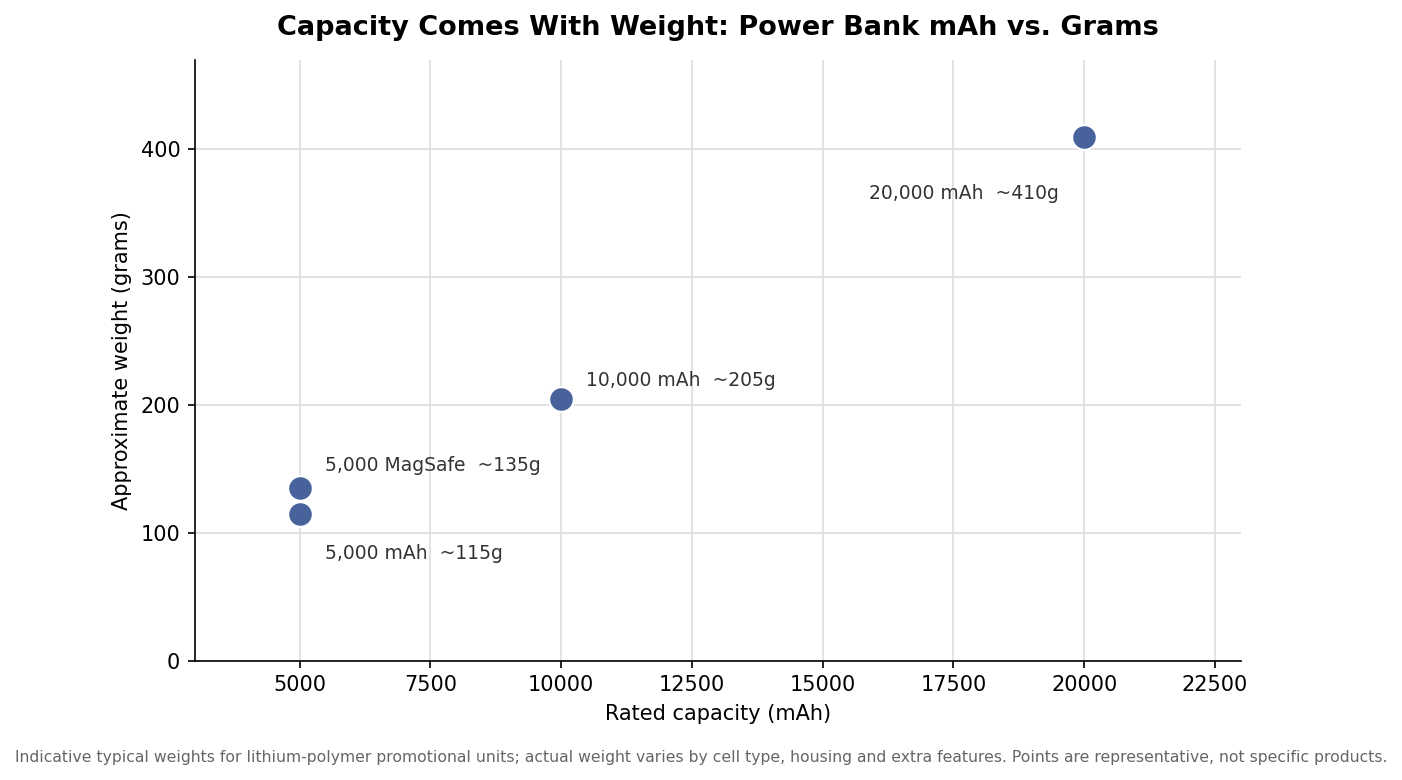
For most giveaways, a 5,000 or 10,000 mAh unit hits the sweet spot between useful and portable, and it costs less per unit, which lets your budget reach more people. Reserve the heavy 20,000 mAh units for audiences who genuinely want them, like field teams or travelers, and say so in how you position them. The weights above are indicative of typical lithium-polymer builds and will shift with housing and extra features.
Forgetting these are lithium batteries you have to store, ship, and hand out
A power bank is a regulated lithium battery, not a plain trinket, and that has three practical consequences people overlook. Shipping them in bulk falls under dangerous-goods rules, so lead times and freight are not the same as for a T-shirt. Handing them out at an event or mailing them to recipients can carry its own restrictions. And lithium cells self-discharge slowly while they sit, so a unit that spends six months in a box can arrive well below a full charge, which reads as a defect to someone opening it. Ask your supplier about certification documentation, plan the storage window, and, if units will sit for a long time, confirm they ship at a reasonable state of charge.
Approving artwork without a pre-production sample
The last mistake is skipping the physical proof. A logo that looks crisp on a flat mockup can land differently on a curved housing, a soft-touch coating, or a small print window, and color on a screen is not color on an anodized shell. On a run of several thousand units, a pre-production sample is cheap insurance against discovering a placement or color problem after everything is printed. Build the few extra days for a sample into the timeline rather than treating it as optional, and check the sample for fit and function too, not just the logo, because the charging behavior and the feel in the hand are part of what your brand is putting its name on.
Leave a Reply