Ordering power banks in bulk looks like a commodity purchase right up until the first quote lands and every line reads differently: one supplier wants 100 units, another 500, and the per-piece price swings by a factor of five depending on capacity and imprint. The chargers themselves are a mature product, so the real work of a bulk order is specifying the right combination of capacity, decoration, and shipping method before you commit. Get those three right and the order is boring in the best way. Get them wrong and you learn about lithium-battery paperwork the hard way, usually with a container sitting at a port.
Start with capacity, because it sets your minimum order
Capacity is the first decision because it quietly determines your minimum order quantity and your floor price. Suppliers group promotional power banks into tiers, and each tier carries its own MOQ. A basic 5,000mAh unit typically starts around 50 to 100 pieces. A 10,000mAh model with USB-C Power Delivery generally runs a 100 to 300 piece minimum. Qi wireless models that charge a phone on contact tend to start at 200 to 500 units, and MagSafe-compatible magnetic banks sit at the same 300 to 500 range. A fully custom, tooled-from-scratch design is a different animal and usually needs 1,000 units or more to justify the mold.
For most branded giveaways, a 10,000mAh USB-C bank is the sensible middle. It holds roughly two full phone charges, it is the capacity buyers now expect, and it stays comfortably inside the shipping thresholds discussed below. A 10,000mAh cell at a nominal 3.7 volts is about 37 watt-hours; even a 20,000mAh unit lands near 74 watt-hours, which matters more than it sounds once the freight forwarder gets involved.
What quantity actually does to the per-unit price
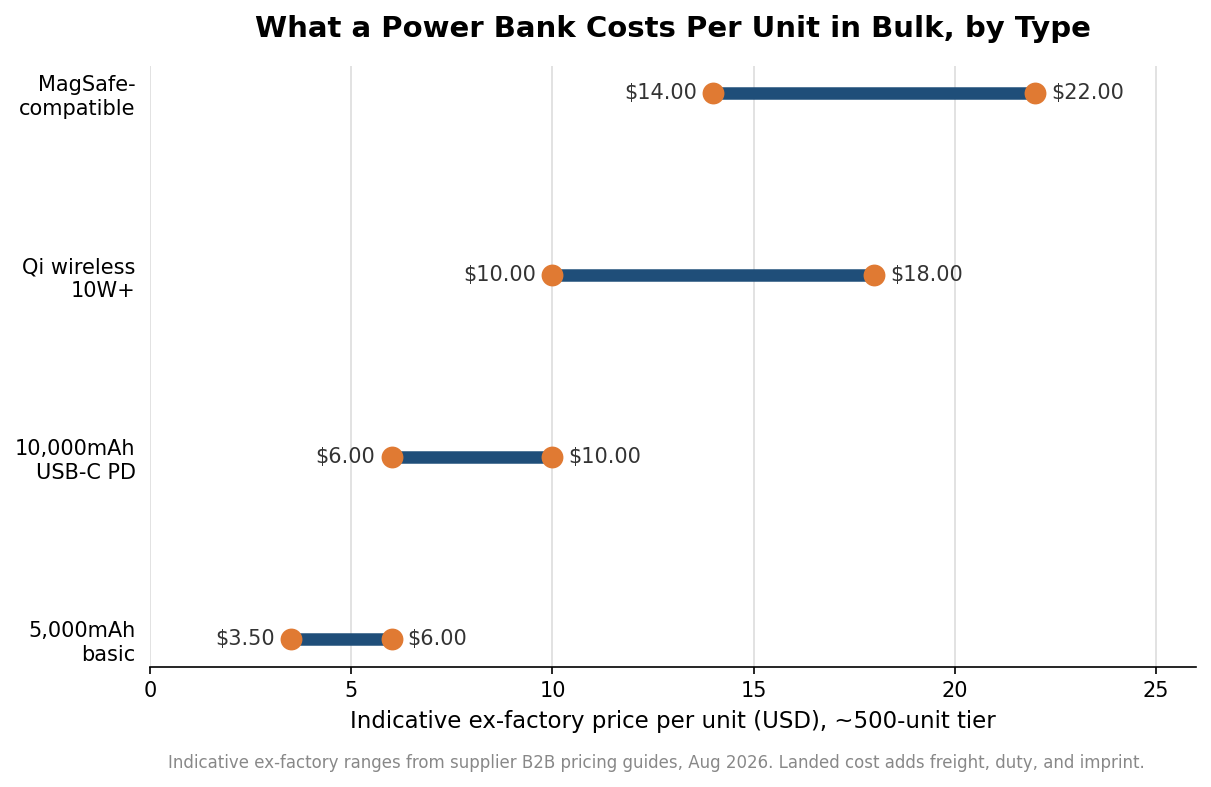
Bulk pricing is real, but it is not linear, and it flattens faster than buyers expect. Indicative ex-factory pricing at a 500-unit tier runs roughly $3.50 to $6.00 for a 5,000mAh basic bank, $6.00 to $10.00 for a 10,000mAh USB-C model, $10.00 to $18.00 for a Qi wireless unit, and $14.00 to $22.00 for a MagSafe-compatible bank. Those are factory prices for the bare unit; your landed cost adds ocean freight, import duty, and the imprint, so treat them as a floor rather than a delivered figure.
The steepest savings come from clearing the first real MOQ, not from chasing enormous volumes. Moving from a no-minimum sample run to a 500-unit order is where the per-piece cost drops the most; going from 500 to 1,000 shaves a good deal less. If a vendor quotes a single flat price regardless of quantity, ask them to break it out by tier, because a genuine bulk supplier prices in bands. Where a figure like this is a range rather than a firm number, it is because capacity, cell quality, and certification all move the price within it.
Imprint method changes durability, cost, and the minimum
How your logo goes on the case is not a cosmetic afterthought; it interacts with both minimum order and unit cost. Laser engraving is the most durable option because it removes or darkens the surface material rather than sitting on top of it, so it will not scuff off in a bag over months of use. It carries a higher decoration cost and generally needs around 100 units. UV printing reproduces full color and fine gradients, works from about 50 units, and sits in the middle on both price and longevity. Silk screen printing is the cheapest per piece for a simple one or two color mark, but it tends to want a higher run of around 500 units to be worthwhile.
Match the method to the lifespan of the campaign. A conference handout that needs to look sharp for a weekend does not need laser engraving; a device you want employees carrying for two years does. If your brand color has to be exact, UV printing holds a Pantone target more reliably than engraving, which reveals the case material’s own color.
The lithium rules that quietly decide your lead time
Every power bank is a lithium-ion battery, which means it ships as regulated cargo, and two documents govern whether it moves at all. The first is a UN38.3 test report, the battery’s transport passport, confirming it passed a battery of tests including altitude simulation, thermal shock, and vibration. It is mandatory for both air and sea freight. The second is a current Material Safety Data Sheet; freight forwarders and customs brokers will not book space without it, and an out-of-date version is a common reason shipments get rejected.
Watt-hours set the difficulty. Units under 100 watt-hours, which covers essentially all promotional power banks, face lighter handling and can qualify for reduced provisions, while anything over 100 watt-hours becomes fully regulated Class 9 dangerous goods with stricter packaging and higher freight cost. There is also a classification split worth knowing: a bank shipped on its own is UN3480 and draws the most airline scrutiny, while one packed with or inside equipment is UN3481 and moves more easily. Sea freight in a full container load is the standard path for bulk stock; air is reserved for urgent samples through a courier’s dangerous-goods service and costs far more.
Building a timeline you can actually promise
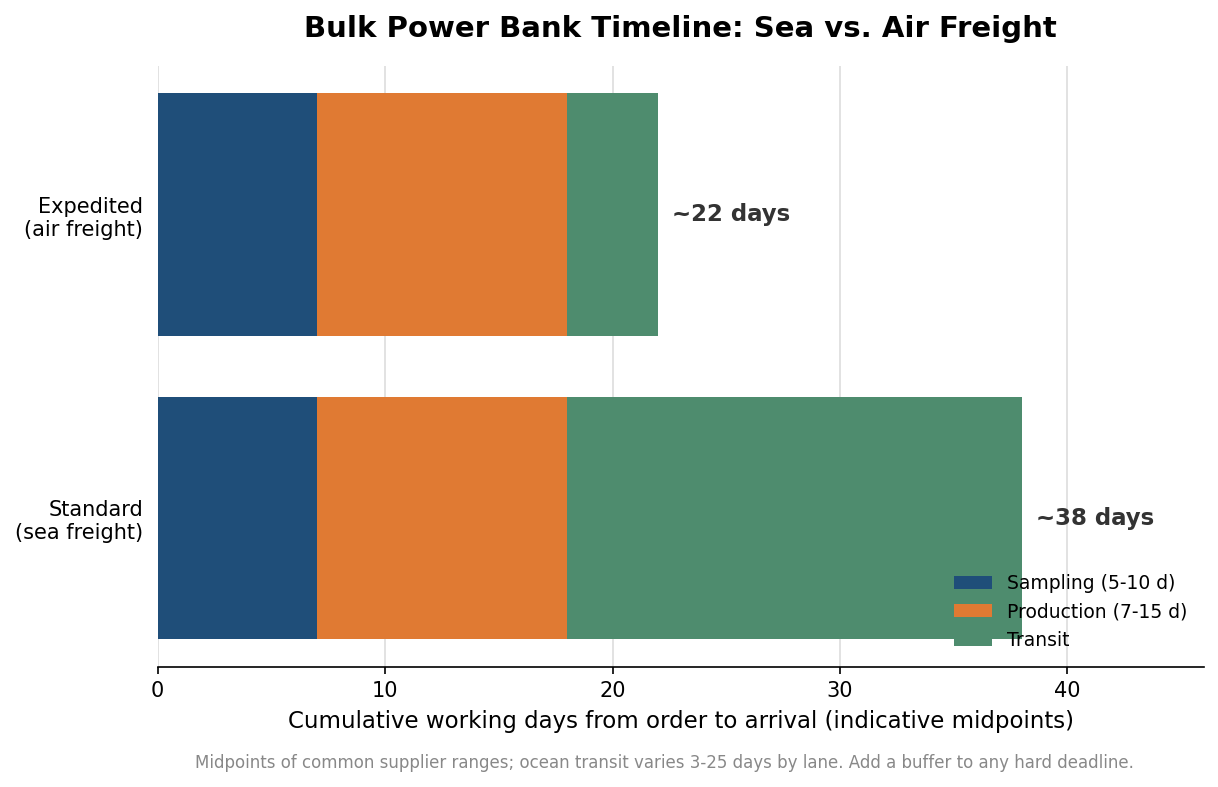
Put the pieces together and a realistic schedule emerges. Sampling runs about 5 to 10 days, mass production another 7 to 15 depending on capacity, and ocean transit anywhere from 3 to 25 days by lane. That is why suppliers advise starting at least eight weeks ahead of any hard date such as a trade show, and the buffer exists precisely because the lithium paperwork and customs clearance are the least predictable stretch. If your event is closer than that, expedited air freight can compress the transit leg dramatically, but it raises both the freight bill and the compliance overhead, so it is a rescue plan rather than a default. Order the samples early, confirm the UN38.3 report and MSDS are in hand before production finishes, and the rest of a bulk power bank order tends to run on rails.
Leave a Reply